

 We all want our children to grow up to be responsible, successful members of society. Isn’t that what you want for your child? So, we “help” them at every turn so that they can make it to school on time, complete their homework perfectly, and get good grades.
But are you really helping or are you harming them?
Let me explain. If your child or teen has ADHD then you know that they struggle with routines, focus and remembering what they need to do as well as, doing what they know they need to do. You may feel that if you don’t remind your teen then they would never get out the door in the morning or finish their homework. And you may be right.
However, providing them with the information they need before they have had time to consider what comes next, does not help them develop the necessary skills to become independent instead it makes them dependent.
Think about these questions:
-
- Are you helping your son or daughter create a routine to get out the door (with everything they need) or are you telling them what to do each day? (Ex. get your shoes on, did you brush your teeth, do you have your homework? And on and on.)
- Are you empathizing and really trying to understand what they are feeling or are you just trying to solve their problem by telling them what they “should” do?
- Are you checking their homework and making them correct it so that the teacher doesn’t know that they are struggling with it?
- Are you reminding them of everything they have to do so that they don’t have to remember on their own?
- Are you waking them up in the morning?
If you answered “yes” to even one of these questions, please keep reading because although you may think you are helping your children, in reality you are not. When you take away your child’s opportunity to problem solve by either telling them what they should do, or by doing it for them, not only do you handicap them from learning the skills but, you are chipping away at their self-esteem and self-confidence and fostering their dependence rather than independence.
For those with ADHD, learning routines and habits can take a bit longer than it does for those without ADHD (66 times). So it is important to start building the skills early so that by the time they get to high school, you have done your job and your teen is pretty independent. You want to feel confident that they can make it on their own at college. On the other hand, if you wait until they are a senior to start “letting go” and just drop the support you have been providing all along, they may not have the skills they need to succeed in college.
So, how can you empower them instead?
-
- Work on one thing at a time. Together decide what it will be. Empower your teen to come up with their own solutions just be sure to include how they want you to “support” them in this new process.
- Instead of saying you “should”…..try asking questions that lead to your teen figuring out their own solutions. Ex. “What do you think you could do to figure that out?” “How can you prevent that from happening again?”
- Learn about Executive Function skills so that you and your teen can better pinpoint which skill is weak. Is it getting started on things (task initiation), remembering (working memory) or finishing things (task completion) etc.? Weaknesses can occur in several executive functions but often there are EFs that are strengths as well. What looks like several areas of weakness could be the same EF showing up in a different context. How can you use the strengths to help compensate for the weaknesses?
- Change comes from within but here are three questions to ask that can help. Can the environment be changed to better accommodate for the weakness? Can the task be broken down into more manageable steps so that it is not so overwhelming? Does there need to be a system or a routine created to assist in solving this?
- Lastly, consider whether or not you are too close to the situation to really be able to help, or if you are finding it difficult to remain nonjudgmental then it may be time to find an Executive Function Coach or Counselor to work with your teen.
Jodi Sleeper-Triplett said this in her book Empowering Youth with ADHD:
…empowerment is about much more than helping the young person with ADHD accomplish goals: It’s about helping the young person identify strengths and resources; practice thinking about how to solve problems and meet goals; build skills; develop a positive self-image; and ultimately, lay a foundation for long-term success in the days, months and years to come. (p35)
And who doesn’t want that for their teen?
 There are two kinds of people – those that love routines and those that don’t. Which are you?
 Calling all parents….do you want to help your child/teen complete their homework more efficiently, study more effectively for tests and ultimately improve their learning and their grades?
 January 1st is meant to encourage thoughts of possibilities but it can also be a reminder of the previous year’s disappointments. For 2024, let’s make a deal, there’s enough negativity in the world, let’s focus on the positive this year. Are you in?
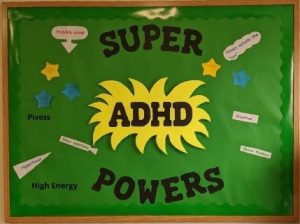
 ADHD, is it a superpower or kryptonite at home or at school? The truth is, it is probably both depending on the situation. All students want to learn, they often feel a great deal of pressure to “learn” and be able to show that learning when it is called for. How can you help your child learn to use their ADHD as a superpower and minimize the effects of kryptonite? Here are three ways to ensure better outcomes.
 Stress. It’s a word we hear every day and I am sure it means different things to each of us (including our kids). The World Health Organization defines stress as, “a state of worry or mental tension caused by a difficult situation. It is a natural human response that prompts us to address challenges and threats to our lives.” Back in the “early” days, stress was meant to protect us from the dangers out in the world and keep us safe. These days it feels more like a byproduct of our everyday lives. Even the general pace of our society can sometimes (no, probably often at this time of year) feel like it is going too fast for us to process and is one stressful event after another.
 October is National ADHD Awareness Month and so in tribute, let’s bring some awareness to how ADHD can interfere in your life and what you can do about it. First of all, ADHD or its side effects, has nothing to do with intelligence. It has a neurobiological (read chemical) basis related to the neurotransmitter hormone levels in your brain. Those chemicals are responsible for transmitting messages from one side of the brain to the other. Sometimes they complete their mission and sometimes you forget part or all of that previous thought.
 I have a love/hate relationship with August, how about you? On the one hand it signifies the ending of the summer (hate) and the transition to cooler weather (which I am welcoming after the hot, hazy, and humid, summer we have had in the northeast – love) but also that transition back to “normal”. Normal as in back to school for the kids and back to your more typical routine and schedule if your schedule has been different during the summer. Do you embrace change or try to run from it?
 It’s summer at last! Let’s take advantage of all that summer has to offer by being more purposeful and deliberate about how we chose to use our time and energy. Here are five steps to help you have a summer of intention and make great memories too.
 Ahhh, the lazy, hazy days of summer are finally here. Now is the time to create a summer plan that will put more summer into your life. Working five days a week, we tend to cram all our summer fun into the weekends. A summer plan is designed to change the routine and add some time to be spontaneous. Being spontaneous applies to what happens naturally rather than being planned or influenced by external forces and the summer is the perfect time for it.