Decision Fatigue is Real – Let’s Make it Easier

Decision fatigueTired of struggling to make the “right” choice?

If you’ve ever stared into the refrigerator hoping that a dinner idea will magically appear, or struggled to decide which task to tackle first off of your to-do list-you are not alone. It’s not because you don’t know what to do, and it’s not laziness, it’s your brain “waving a little white flag, especially if you’re juggling ADHD, high expectations, or have a habit of putting everyone else’s needs first. The more decisions you have to make in a day—big or small—the more drained you feel.” 1  That’s decision fatigue.

Decision Fatigue

Every day we wake up with a certain amount of mental energy and each decision or choice we make uses up some of that energy. So, as the day goes on and our decisions start to add up, our mental energy decreases. That’s when decisions become harder to make and so you might put off making them, or feel stuck, or make a hasty decision you’ll regret later.

Give Your Brain Space to Breathe

The first step is to reduce the number of choices you need to make each day. That will free up some of that decision making energy for you to use on the more important things and give your brain space to breathe. Think about how many decisions you are making just to get up and out in the morning. (Ex. What time to get up, what to do first, what to wear, what to eat, etc.)

How to reduce the number of decisions? Simplify the choices you have to make early in the day and create routines that become automatic habits that no longer require mental energy.

Where to Start?

Start with the easy things that don’t take much brain power at all that you can do the night before. Things like deciding what you will wear, what you will eat for breakfast, what you need to bring with you, etc. If you set out what you can, then that part of your morning will go smoother.

The next phase would be to simplify what you can by planning ahead. Where do you feel the frustration building? For me, it was often around dinner. I was all out of decision making power by the time I was supposed to start working on dinner. I would stare into the fridge or pantry and hope something would jump out – it rarely did. Now, I use a blank calendar on the pantry door to write in the meals for the next week. Usually, it goes from Thursday to Wednesday so that I can get what I need on Thursday at the grocery store. When I am creating the menu, I put anything that I might need on the Alexa shopping list. It’s not perfect but it does have an added advantage….if I am not home or am on a call, anyone else can check the menu and get started on dinner.

Other ideas you might want to try is to designate certain days of the week for certain activities like admin, meetings, grocery shopping, errands, laundry, etc. That way you know when something will be taken care of and don’t have to try and fit it in when it becomes urgent on a very busy day.

Creating routines can also help to take the strain off of your brain. Yes, it can be boring to do exactly the same things in the same order every day – but you are saving your decision-making power for more important decisions later in the day. A morning routine and an evening routine would cover the basics but you can also create an end of the work day routine, a weekly reset routine, or even a bedtime routine with the kids and be instilling great life skill habits in the process. Once these routines become autopilot, your brain can relax and save it’s energy for more important things.

Take a look at the times of the day or the things that seem to cause more stress in your day and figure out if a routine would help, or if you can simplify it or do it the night before or even delegate it. The choice is yours. If you feel like you’re just “burnt” at the end of the day, then it’s time to also look at your self-care habits to make sure you are getting enough sleep, exercise and healthy meals. After all, you are worth it.

Take 5 minutes today to set up one “go-to” or default option – a quick breakfast option or an outfit you feel great in, whatever it is, set it up and try it out. Let us know on our facebook page, the impact it has.

*1 Chatgpt definition

From Busy to Effective: The Art of Balanced Productivity

Personal producitivtyPersonal productivity, is the art of getting things done or as ChatGPT defines it, “Completing tasks, managing time, and achieving goals in your daily life or work.”

Are you happy or should I say satisfied with your level of personal productivity?

Let’s take a closer look at that definition. The first thing it mentions is completing tasks. What tasks does it mean? If it is the tasks on my to-do list then there isn’t enough time in the day to do all of them. How do I choose? We’ve all had an extremely busy day of getting things done but at the end of it, we either can’t cross anything off the list or we feel like we really didn’t accomplish anything important.

Every day, everywhere we look we are exposed to all kinds of options and choices. Sure, we’d like to do it all, but it is probably not humanly possible. So, we have to make choices. Choices should represent the important things, those high impact tasks that make a big difference but are not a lot of work. Knowing ahead of time what those tasks are takes some thought (usually ahead of time) to be most effective.

One way is to create a realistic plan for the week based on the available time you REALLY have and then ask yourself, “What is really important for this week?” If you have a master list of your tasks, then just going through that will trigger the important things but remember….you can’t (and shouldn’t) try to do it all.

Take the tasks that you feel need to be done this week and write them down on a new list. Now, based on the available time you have, the time of day, and the priority level of the task, decide where in the week will you get that done? Having a plan allows you to see not only what the most important task is but also, how other tasks may be grouped together to save you time and energy. Estimate how long your tasks may take to be sure you are not trying to be a super hero.  Or you can wake up slowly on Monday morning and wonder, “What do I feel like doing today?” I know I would go for the easiest tasks but those are not usually the most important ones, are they?

Managing Time

Managing time is mentioned next in the ChatGPT definition above, but what does that mean? I certainly don’t know how to “manage” time, in fact it often flies by without me even noticing it, how can I manage it? Did you notice after the clocks changed, how much faster the day went by? It wasn’t really faster, it just seemed like the day was longer, because the sun was out longer. Time ticks away a minute at a time no matter what we try to do about it. We can only “manage” ourselves by following our plan, limiting what distracts us (unless it’s our kids) and having clear boundaries around our time.

You can “save” time by having habits and routines that keep the family current.

Which would you rather….

  • Do 2 loads of laundry or 7?
  • Take 30 seconds to put dishes in the dishwasher or wait until the sink and counters are full?
  • Know what is for dinner and have it or figure it out at 7:30pm?
  • Have kids put their toys away before bed or risk stepping on a Lego in the dark?
  • Start the week with a full tank of gas or risk being late for that meeting because you had to stop for gas?
  • Paying your bills on time or risk having to pay the late fee?

By having set days or times that you do certain tasks automatically, you can save energy and time and lower your stress. When the children are involved in the daily chores, they develop accountability and responsibility. Working together can build their confidence and self-esteem. Pitching in can develop cooperation and teamwork while they learn essential life skills like organization and time management. It’s a win-win situation.

Achieving Goals in Your Daily Life or Work

The third and final piece of the personal productivity definition is, “achieving goals in your daily life or work.” A goal can give you a glimpse into the future and maybe provide motivation when things become difficult. It is your “why.” It points you in the direction of your best self but it doesn’t tell you how to get there.  That’s where “PACT” can help. PACT is an acronym, similar to SMART that is used to create goals, but PACT is more focused on the actions needed to attain a goal. PACT stands for Purposeful, Actionable, Continuous, and Trackable.

PACT pushes you to go deeper and to think about the actions needed to get to your goal. It focuses on output – actions you can do now to move you in the direction of that goal. If that doesn’t work, the “C” encourages you to try something else. Continuously working towards your goal by designing different experiments, like a scientist might, to collect the data on your results. You can easily see that because you are keeping track and adjusting when necessary.

So, if you are looking to improve your personal productivity, first, think about why. Why do you want to be more productive? Is it just to get more done? I hope not. Is it to follow through on what you have already agreed to and is it essential enough for you to give your irreplaceable, and limited time to? If not, then let it go. There is a big difference between what we need to get done and what we “want” to get done. Check your list, cross off anything you can. Focus on the important things – those things that move you in the direction you want to go in. It’s not about how much you get done. It’s about getting the important things done and to do that…..

Make sure to:

  • Take care of yourself
  • Create habits and routines that make life easier
  • Plan ahead
  • Reset nightly for the next day
  • Get the family involved
  • Focus on the important things
  • Take time to recharge

If you’re feeling overwhelmed or confused on where to start, then use the above list to help you figure out a PACT goal that will lead you to the actions you need to get there. For example:

P – To have enough energy to feel good and get through my day

A – Go to bed at 10pm every night

C – Might need to go screen free at 9pm

Or make sure the kids go to bed on time

Or shower in the morning

T – Track what time I do go to bed (and how do I feel the next day) That is one simple example of how you get to “taking care of yourself.”

Now it’s your turn, what is one thing you can do to increase your level of productivity? Let us know on our FB page.


Image by TyliJura from Pixabay

Does Homework HAVE TO be a Battle?

Homework frustrationThe simple answer is NO! Homework does NOT have to be a battle.
The purpose of homework is to help reinforce the learning from class. It is also to encourage responsibility, independence, the development of time management skills (which are really self-regulation skills) and practicing problem solving strategies. Sounds great, is that what is happening in your home?

Or are there tears, tantrums, yelling, defiance and meltdowns? Or maybe it’s bribes, rewards or threats of losing what they hold most dear. What’s a parent to do if the kids are just not motivated to get started on their homework?

Where’s the Motivation?

Motivation is a challenge. An ADHD brain struggles with tasks that are boring, complex or difficult. If you are trying to motivate your child to complete something that falls under one of those categories, (like some homework) it may be as frustrating for you as it is for them.

“Motivation is a set of habits and routines, guided by your values and your identity, that you carry out every day.” “When you combine purpose, energy and small simple steps, you get sustainable motivation.” says Jim Kwik, author of Limitless.  Are you ready to change this?

How to Make Homework Less of a Battle

Create some structure – the school day is very structured. Students know what is happening each day and at what times. There are routines in the classroom that are followed and the expectations are clear.

James Clear (of Atomic Habits fame) says, the smaller the step, the more likely you will be motivated to do it. He also suggests that you schedule when you will work on it because you are more likely to work on something that has been scheduled rather than waiting until you feel motivated to work on it. Waiting for that feeling – rarely happens but you can help encourage motivation by setting up a routine that tells the brain it is time to get working on “x”. Clear calls it a “pregame routine” where it starts a series of motions that are simple to do but moves you in the direction of actually working on whatever it is. We’ll call it the “pre-homework routine.”

Pre-Homework Routine

At home, there should be clear expectations, structure and routines as well. Starting with what happens when they come home from school. Decide together what is the littlest thing they can do? For some that might be closing the door – others it might be taking the lunch box out of the backpack and putting it in the kitchen. Baby steps to start and then:

  • A protein snack will help recharge their tired brain
  • Taking 30-45 minutes of downtime (especially outdoors) will help to reenergize them.
  • Screens are a distraction and a time suck, so should be avoided until after the homework is done.

Homework is your child or teen’s “job” – they are accountable to their teacher, but more importantly to themselves. If they don’t do the work, they will get the zero. If they are not motivated by grades, just keep showing them the grade portal and the impact of each zero. No one really wants to fail. Sometimes, all the fuss is not about starting the homework at all. Sometimes, they are feeling overwhelmed or frustrated or even confused. They might be looking for your attention or trying to manipulate you into letting them disrupt the routine. Try to understand what is really bothering them. Offer some options, show empathy and encourage them but don’t let them manipulate you into postponing the homework routine.

  • Set a “homework time” to begin each day after their initial break. They can take short 5-minute breaks after each 25 minutes of work time (depending on age).
  • Designate a desk, table or counter as the homework zone and make sure it is clear and relatively distraction free. Check the chair and the lighting and put an analog clock within view.
  • If they choose not to work during that time, make it clear there will be no homework being done after a specific time. They need to have time to “chill out” between homework and bedtime.

The role of the parent, just like the teacher, is to set clear expectations around the homework routine and process. You are helping them create habits that will serve them their whole life.

  • Encourage independence but be available to guide them to their own solutions when stuck. Don’t provide answers.
  • Keep it positive. Praise their effort and persistence rather than their intelligence or skill. According to ADDitude Magazine, “When you praise your child, it creates dopamine — the neurotransmitter his or her brain lacks, which causes the ADHD symptoms— and the dopamine helps them to better control behavior. So, he or she can do more wonderful tomorrow.” It also helps to increase the positive/negative ratio. Do you know that it takes 3-5 positives to offset 1 negative comment?
  • Check on them occasionally but don’t interrupt them unless they are clearly distracted. Each interruption adds more time to regain their focus.
  • Be consistent as much as possible. Use a calendar that everyone can see and let the kids know what is coming up.
  • Each week, help them “reorganize” themselves by cleaning out their backpack, checking the agenda for what is coming up and depending on their age, making sure they have clothes for the week or have them do their laundry.

It will take longer than you think for the homework routine to become mostly automatic. Use a timer or something that lets everyone know it is time for it to start and stick with it. Creating routines reduces the stress of not knowing what to do next, helps a struggling working memory and best of all takes the battle out of the homework.

Learning happens when students are willing to learn, and have strategies that work for them like a homework routine. However, most important is that they feel good about themselves. So, use lots of praise (about their effort), humor and help them understand how they learn best. If school is a positive experience, then their superpower may one day make the world a better place.

Slow and Steady Makes A Productive Day

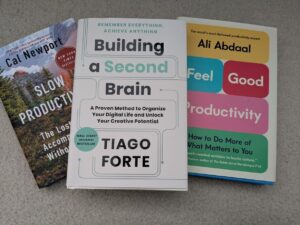
Productivity BooksEvery day in multiple ways we are bombarded with information. Whether it is auditory, visual or both, information is all around us even if we don’t want it to be. According to an article in the NY Times, in 2009, as quoted in Building a Second Brain, by Tiago Forte, “the average person’s daily consumption of information now adds up to…34 gigabytes” or about 174 newspapers worth per day. A quick Google search shows it is now up to 74 gigabytes or 16 movies worth a day! Who could sit for that long?

There’s a problem with too much information whether we are consuming it ourselves or are just being exposed to it. We can’t hold onto the information long enough to use it or remember why we read it in the first place. Even if you could remember it, could you find it? What is the point of this new knowledge we’re learning if we can’t use it to improve our lives in some way? Students must wonder about that all the time.

What is Productivity?

If you’ve ever felt overwhelmed or like your brain was about to explode, then you know it is a stressful feeling and it interferes with your ability to get things done.

We all want to be more productive; it is one of the most common New Year’s Resolutions. Well, chatgpt defines productivity as, “how efficiently and effectively you use your time, energy, and resources to accomplish tasks, achieve goals, and improve your overall quality of life.”

To improve your overall quality of life is the key point, because what is the point of doing more if you just feel unhappy, stressed, overwhelmed, or brain dead?

How to Start

In order to make good decisions about the tasks and projects that are important to you, you need to know what they are. When was the last time you wrote down EVERYTHING that was on your mind? (I call it a brain dump but some prefer the term a cranial cleanse.)

Remember a project is anything that has two or more tasks/steps before it is complete. Maybe just think about the projects you would like to complete in January. No, you can’t do all 100 of them, but you might be able to finish 2 or 3 of them and remain sane at the same time. How would that feel?

Steps to Slow Down and Do More

    1. Work on fewer projects. Cal Newport, author of Slow Productivity, suggests not taking on a new project until one of your initial projects is completed. We often try to cram more work into an already overloaded schedule, without thinking where that time will come from. So, making space first makes sense. (Hide the rest of the list until you are ready.)
    2. Before you decide on which projects you will take on, think about what would make you feel fulfilled and pleased to have accomplished by the end of this month?
      • Is there something you have been meaning to do concerning your health?
      • How about a Home project that is haunting you
      • But most importantly, is there something you want or need to do that would make you feel productive and possibly even recharge you?
      • Make some time daily or at least weekly that you can do whatever it is that recharges your batteries. Even just a trickle charge can keep those batteries running during the coldest (bleakest) of times.
    1. Now based on the projects or areas of your life that you have listed to work on, set up a digital folder or notebook page to collect incoming information that will be helpful for it. Keep track of the info you consume in a way that allows you to use it later. This comes from Building a Second Brain. The concept is simple, take notes and keep them in a digital app that you can search and use easily.

Is being more productive about managing your time better? What is time management really? We can’t manage it or slow it down or save it to use later. It is really about energy management. Your energy is what determines how well you get things done. By collecting the information that is important to your tasks and projects, and putting it all in one place, you are saving yourself time, effort and brain bandwidth. Cut down on the information you really don’t need as it just takes up space in your memory and often isn’t a priority of yours anyways.

Do remember to take good care of yourself including; sleep, nutrition, movement, and screen free down time so, you can feel your best. Everything is more difficult if we aren’t feeling our best, don’t you think?

Seek out the resources and the tools to help you manage your tasks and limit what you are focusing on so it is more manageable. That should help you save time and mental energy. Good luck.

That’s a Wrap On Another Year

Wrap up the yearAs my friend and fellow Productivity Coach, Colleen, said recently, “and just like that it is December!” Yes, December is here, marking the end (almost) of another year. As we close the door and wrap up another year, do you think it was a good year? I hope so. If you’re like me, you might need some help remembering what you did do in early 2024 and not just what you didn’t do. Our brains naturally hang onto the negative more than the positive so before we judge how the year went, let’s take a step back.

Time to Look Back

        • Grab your planner, calendar, phone or sticky notes from 2024 and let’s go back to January.
        • Look for the positives, big or small, you should celebrate them all
        • Any milestones for you, your family or friends?
        • How about vacations, weekends away, social events?
        • What were the challenges, or obstacles you faced and what helped you through them?
        • How did the holidays and special occasions go?
        • Now think about the different areas of your life (health, family, work, etc.) whatever they are for you. Rate them on a scale of 1-10. You can use the pie chart below. Consider the point/center of the pie to be zero and move up the slice with the edge = 10. You can change the categories to fit your life. Any areas you might want to improve on? Write those down.

          Life with ADHD
          Which slice of pie needs work?

Once you have refreshed your memory on the past year, it is time to think about next year. What are the categories with the lowest scores? Any areas where you would like to improve? Pretend it is December 31, 2025 and you are again reviewing your year. It was the best year of your life! What have you learned? How have you grown? Now, figure out what has to happen to make that a reality.

Get Ready for 2025

        • Decide – will it be a paper planner or digital calendar?
        • Add in the dates you already know. School vacations, ½ days, holidays, birthdays and anniversaries.
        • Special events – weddings and other celebrations with the details
        • Vacations and reservation numbers, flights, etc. (Reminders to bring your passport and phone charger – you get the idea).

Don’t just add in the dates but be sure to leave yourself notes about what you’ll need. Will you need a gift? What will you wear? How will you get there? Thinking about those details in advance can save you lots of time and energy.

How about the holidays too? What would you like to tell future you about this holiday? Did you maybe wait a bit too long to start that tree skirt that is long overdue? (Yup, I did, but there is no time for a do-over so I’ll keep at it.)

I do like to summarize the holidays in my journal – after they are over. It’s a good reminder to read the last two or three years before the holiday, to refresh my memory. Each year gets easier and this year, I am keeping track of things in Notion. (It’s an app that works like a second brain). That way I can see what I can do to improve next year and even keep track of gift ideas, recipes, and clothing sizes throughout the year.

Whew! That may seem like a lot to think about but, when you are more prepared for whatever life throws at you – you’ll be glad you took the time to prepare for your best year ever!

Keep Calm and Celebrate: 5 Stress Busting Strategies to Use Now

Stress BusterIt’s official, we are in the holiday season. With Thanksgiving falling at the very end of November, it seems everyone is getting into the holiday spirit a lot earlier this year. How about you? Do you feel your stress level increasing at this time of the year as you try to juggle multiple responsibilities? Here is some help to ease the stress.

Here are my 5 Stress Busters:

              1. Declutter – not your typical way
              2. Prioritize health
              3. Create a realistic plan
              4. Stress free zone
              5. Reduce and unplug

Stress Buster #1:Declutter Important Spaces

If you are entertaining (or would like to) this holiday season but feel a bit overwhelmed by the clutter around you, then I am sorry to tell you that now is NOT the time to declutter or organize. Sorry to tell you that, but that doesn’t mean you can’t make things easier on yourself quickly and painlessly so that you CAN do the hosting you want.

There are three areas of your home that you probably use for guests. The living room/family room/great room where the entertaining happens, the kitchen where you do all the preparing and the bathroom, are the three key areas to declutter.

Step 1: Get a trash bag and a recycle bin and go as quickly as possible around those three rooms in a clockwise manner and toss, or recycle whatever you can. (Estimate:<30 mins)

Step 2: Find as many bins and boxes as you can and head to the bathroom with one or two. Put away anything that belongs there and load what doesn’t belong or doesn’t have a place, into your bins or boxes. Is the counter clear? How about the floor? Wet towels go in the laundry bin not the decluttering bins😊 (Estimate: <15 minutes)

Continue this process in the entertaining room. Start to the left of the doorway and work your way around the room in a clockwise manner loading whatever doesn’t belong or does not have a “home” into the bins. You could also make bins for each family member to take care of their own things rather than storing them. We all know our family and friends are probably not judging us, but when our homes are overwhelming us, it is harder to focus on others through our own embarrassment. When you feel good about your space, and it works, you can relax and enjoy. (Estimate: <60 minutes)

Lastly, it’s time to tackle the kitchen. This is probably the most difficult space to clear out but also the one with the biggest impact. Imagine working in your kitchen with clear counters and finding the tools you need quickly and effortlessly. What would that feel like (first name?) Now remove anything that you won’t need for entertaining into a bin. Start from the sink and move clockwise, touching things only once to put into a bin or return to its home. For kitchen items you might want to categorize what goes into each bin, just in case you need something in a hurry. (Ex. Extra pans, knick knacks, appliances like instant pot or extra storage containers, etc.) (Estimate: <90 minutes)

Step 3: Remove all the bins to some other space where your guests won’t see them but where you can access them if necessary. Take a look around, how does that feel?

Step 4: Now it should be easier to quickly clean these spaces. (For your family’s health, please use products that are environmentally friendly and people friendly. Chemicals and fragrances can be harmful to your health.)

Stress Buster #2:Take Care of Yourself

Holidays are no fun, if you get sick. Yet, that’s when we tend to squeeze more things into an already overpacked schedule. Eating and sleeping tend to get less attention the busier we are, but have the greatest impact on our energy and health. With some advance planning you can have quick and healthy options ready. Make a list of your favorites and the time it takes to get them ready. Looking at a list to pick from is so much easier than trying to think of what you can make when it is already late and you’re starving. Better yet, make a meal plan for the week.

Stick to a bedtime, seven days a week. What time will that be? That is up to you, but it needs to be consistent or your body will call you on it. Getting some sunlight in the morning or afternoon can help reset your circadian rhythms making it easier to fall asleep. Reading for as little as 7 minutes is also supposed to help. Some people find listening to audible books or the calm app is helpful. Making sure to avoid screens (TV included) for 60-90 minutes before bed helps melatonin do its job. Aim for at least 7-8 hours so you can wake up refreshed.

Stress Buster #3: Your Plan

Create a REALISTIC plan. I know your cape comes out at this time of year and you become a superhero but, as your coach, I have to ask you, “what is it costing you?” When you are running on adrenaline and cortisol, it takes a toll on your reserves. You know those things that when they run out, you end up exhausted, cranky and sometimes sick.

A realistic plan starts with knowing what you “have to” and “want to” do in the next few weeks. Maybe brain dump (cranial cleanse all those thoughts) out onto paper. Get the family’s input and put rough estimates on the time each task takes next to them. Add them up. Humanly possible? Probably not. What can go? What’s really important and where can you schedule it in? Make sure your calendar is already up to date with school scheduled events, family parties and appointments. Now try to fit in 3-5 similar tasks a day, several days this week. Keep weekends open for fun and Sunday prep for the week time if possible. Any events in the future you need tickets or reservations for, book them now. Sometimes the future seems so far off and then suddenly….it’s here.

Stress Buster #4: Stress Free Chill Zone

Create a stress-free zone. Any area where you can go to relax and/or spend some time doing something you love without thinking about all the other stuff you still have to do. You need some downtime to recharge and clear out the brain RAM so you are ready for whatever comes next. Try to take a 30-60-minute break for yourself each day, (I know it seems impossible) but the benefits are incredible! Unplug, be creative or just take a catnap – whatever helps to recharge your batteries give it a try and see what happens.

Stress Buster #5:Limit the Negative

This is probably the toughest, yet, most effective stress buster if you want to relax and unwind at home – reduce your exposure to social media and the news. It is hard to escape the constant attention grabbing, sensationalism, that the news has become. From verywellmind.com…

“…constant exposure to negative information can impact our brain,” says Annie Miller, MSW, LCSW-C, LICSW. Consuming the news can activate the sympathetic nervous system, which causes your body to release stress hormones like cortisol and adrenaline.” Even if the news is just background noise it was shown to have a negative impact.

Reduce your exposure and you will reduce anxiety, worry and fear that often comes with the news. The article goes on to suggest doing something to “energize and enrich” your life rather than watching what makes you feel worse. Maybe head to your stress-free zone or have a family game night, do a puzzle, watch Hallmark, hang some decorations – whatever you see as positive. I hope it will also help you sleep better. Your brain continues to process whatever you have done or seen in the last 30 minutes once you are in bed. No wonder we can’t sleep!

This is the time to protect yourself and your family from the stress of the outside world. Your home is your sanctuary and it should be filled with love and calmness that nurtures and recharges you and your family.

ADHD Hacks: Empower Yourself with Strategies, Not Labels

Aware and EmpowerOctober is ADHD Awareness/Empowerment Month. Each year the media, and the three national ADHD organizations, provide information on the latest scientific research to publicize and educate. The myths and misinformation continue to interfere with individuals seeking or getting help but, these three organizations are trying to help CHADD.org, ADDA and ACO.

Does it matter if you have been “officially” diagnosed? I don’t think so, unless you feel medication may help. Always talk to your doctor, of course, but medication doesn’t teach strategies and structure. Those are things you can try on your own. You can “experiment” with different ideas and then evaluate their success or failure. Pretend you are a scientist, and just collect the data – what worked and what didn’t and then build from there. No guilt, just learning.

What is ADHD?

ADHD is a neurobiological condition – meaning it is the result of lower levels of neurotransmitter chemicals that are important in the brain, which results in lower levels of stimulus in the brain. Non-technical definition: it is a chemical imbalance and not a personality/behavior or motivation problem. Just like near sightedness or hearing loss, it cannot be “fixed” at this point in time, but it can be helped.

Many people with ADHD are often very intelligent, but they may have difficulty showing it at times. That’s often a combination of the lower level of brain chemicals and difficulty with their executive function skills. Dr. Thomas Brown believes there are “6 clusters of executive function skills: activation, focus, effort, emotion, memory and action.” These executive function skills work together to help us get things done. (FYI they are not fully developed until around age 25 and yet we use them every day.) Inside these “clusters” are things like organization, planning/prioritization, working memory, self-regulation, focus and time management. Ever struggle with any of these?

Start Here

One of the most important, yet often most difficult things to do, is to consistently get a good night’s sleep. You know you feel better when you are well rested and are often more capable of handling frustration, stress and overwhelm without the added guilt of cookies, ice cream and/or junk food.

Meditation, relaxation exercises, and taking breaks can help manage those impulsive emotions before they break through. Remember, ADHD is a chemical imbalance, it is not “who you are”. Be gentle with yourself and keep those ANTS away. (ANTS=Automatic Negative Thoughts)

What do you need to do to create a nighttime routine that will help you get a good night’s sleep (most nights)? We’re not looking for perfection, just a routine that can become a habit. Include some screen free time, cozy pajamas and whatever else helps your body get ready for sleep. Reading in bed has been shown to be helpful for getting to sleep depending on what you are reading, of course. Give it a try, just don’t give up.

Organize for Ease of Operation

Are you a problem solver or a tolerator? (If that’s even a word). Think about the morning, when you are trying to get ready for your day, or get kids off to school. Is it calm and stress free or hectic and frustrating?

What is getting in the way and preventing you from a smooth start? (Hint: systems, routines and habits, oh my)

Are there:

    • Dishes in the sink from the night or days before?
    • Cluttered counters so there is no place to make breakfast or lunches?
    • Full dishwasher?
    • Crowded closet, yet nothing to wear?
    • Missing keys, pocketbook or left shoe?
    • Kids that need 98% of your attention to get ready?

Whatever it is, you can figure it out. You’re a problem solver and you can put systems and routines in place and get the family involved. Or you can continue to tolerate it and pretend the stress isn’t affecting you and impacting your relationships and your health. (But it probably is.)

Simplify, Simplify, Simplify

Declutter – things are just things. But they suck up time and energy both physical and mental every time you have to move them or work around them. They add frustration to your day when they are hiding your keys from view. If they don’t bring value or sentiment to your home then, they are just stealing precious moments of your life.

Clutter impacts your family whether you realize it or not. Visual clutter can easily overwhelm a brain with ADHD, increasing everyone’s stress level. Or maybe clutter is interfering with your motivation to prepare family dinners so you opt for quick microwaveable and possibly less healthy options.

Good nutrition is important for all brains throughout the day. According to Children’s Health, “good nutrition not only helps bodies grow strong – it can also help kids focus and even improve their behavior.…. While the right foods are important, it is just as important to help your child eat at consistent mealtimes throughout the day and to avoid hunger.” Craven, the author, goes on to say “That children need three meals every day and one to three snacks as well so, they should be eating about every three hours.”

Decluttering can save you time, money, energy and brain bandwidth. Clutter, most importantly, takes time away from the things that really matter. What can you do today to reduce the clutter in your home and life? Start today, even 10 minutes done consistently can make a huge impact.

Battery Recharge

Having ADHD can make it difficult to remember tasks at the right time and place, and it often distorts our sense of time—speeding it up unexpectedly, which can leave us feeling rushed or running late. When time is short, self-care is often the first thing to go. If your “batteries” are running low, the first thing to do, is to stop pushing yourself. Take a few minutes to do something that will help you recharge.

When you take care of yourself first, you are better able to take care of others. If you have kids that have ADHD, then these are three very important words to remember: consistency, predictability and simplicity. Dr. Jacque mentioned them as foundational for reducing anxiety and helping kids with ADHD thrive with fewer disruptive behaviors.

Managing the things you can, can help lower your stress level and give your ADHD superpowers a chance to shine. You’ve got this!

*********

What Your Child/Teen Wants You to Know about ADHD

ADHD helpHey Mom/Dad (or Parent),

We are about to start a new school year and I am worried and scared that it will be like last year. I really do want to do well, but my ADHD keeps getting in the way and I don’t know what to do about it.

I do know that I get very upset when you raise your voice (yell) at me or ask me things like, “why didn’t you…” and then my brain just shuts down. I want you to be proud of me but, when your voice is loud or you use a different tone of voice, it makes me think you are mad at me. Could we celebrate my successes more and not focus so much on my grades because I am doing my best?

I know I forget things but reminding me a hundred times doesn’t help me remember. In fact, each time you interrupt me while I am doing my homework, it adds 15-20 more minutes for me to refocus on what I was doing. No wonder I finish my homework right before bedtime. I’d like to have some free time before bed to relax and chill out. Maybe that way I would be able to fall asleep faster and feel better in the morning.

How about we don’t talk about homework when I get home and instead let me have a snack, as I am having lunch very early and then I can to outside, or relax, and recharge a bit before starting homework. Then after about a ½ hour (say 4pm) I will start on my homework. Don’t ask me what I have for homework if I don’t have my agenda open in front of me. That’s why I write it down – so I don’t have to remember it. No interruptions please! I will take short breaks so if you have something to ask me, please wait until then.

I would appreciate it if every week you would tell me what appointments or after school activities I have, so I can put them in my agenda/planner. I don’t like surprises or changes in plans! And I don’t want to have something EVERY day after school. I need time to myself, to do what makes me happy so I can recharge.

I like to be able to predict what comes next, so if you can help me figure out a good bedtime and wake up time so I have time to do everything I need to without missing the bus, that would be helpful. (Use an alarm clock, not a phone.) If you help me make it a habit, then you won’t have to remind me of every step I need to do. That would be a relief! I can sometimes still hear your voice telling me what to do when I am on the bus.

Also, can we get all the clothes that no longer fit me, out of my dresser? It is so hard to find what I want to wear. I need fewer options and I need to figure out what to wear, the night before. My room needs help too. It is always so messy that I can’t work at my desk. What can we do to make it work better?

As for my homework….I don’t need you to check it for accuracy because that is my teacher’s job. I don’t need the answers either, but sometimes I just cannot understand the directions, or I have forgotten how to do it, or it is just too boring or complicated. Encourage me to think of other resources I can use to find the answers or help me break it down into more manageable pieces.

Let’s use technology where it can help me with reminders and alarms but save the gaming stuff for after my work is done. You know how easily I can get distracted:-p

Please tell me later if I said or did something that upset my friend as sometimes, I have no clue what he meant by what he said or how his face looked. Friendships are hard, but really important to me. I want to be a good friend.

Please be patient with me as I learn new skills. My teacher says that my brain isn’t fully developed yet and that I might need help developing strategies to help myself. I don’t need your strategies, just your help in figuring out what will work for me. And I like simple and easy.

So, if we can work together on these things, with patience and understanding that I am doing my best, I think I will be more independent and have more confidence in what I can do for myself.

Thanks Mom, (or Dad) I know you want the best for me, but this is who I am right now. With your help I can grow in a positive, self-confident way and take on the world!

Love,

Your child/teen with ADHD

Summer Balance – What Does That Mean For You?

juggler mom trying to balanceWe’ve all heard the term “work/life balance” and its implied connotation that it is possible to achieve a 50/50 balance between work and our other responsibilities to ourselves and our families. I believe that we each have to find our own sense of “balance” and the summer is the perfect time to change things up. What do you think?

Time Management

Time is the one resource that we cannot make more of so, we need to find ways to be more efficient. I am not talking about multi-tasking! When we truly multi-task we are actually flipping from one thing to another and it is about as effective as losing 20 IQ points.

However, here are a few things to think about:

  • Do you start each day with a prioritized plan?
  • Do you create time blocks to do similar tasks together?
  • Are you clear about your work and personal boundaries?
  • Can you take advantage of flexible hours, such as earlier or later start times or working longer to have a ½ or full day off, or working from home?
  • Do you have morning and evening routines that work for you with very little thought?

Recharging Your Batteries

When we make more time available, it is important that we know what we want to do with it. It can be as simple as taking time for a walk after dinner, or reading a book under a tree or more of a project like planning and taking a family vacation. Recharging activities just seem to be easier in the summer. Of course, this year we have had some extreme heat, so remember to stay hydrated and don’t overdo.

Think about:

  • Planning a weekend away or a vacation (and taking it)
  • Adding some exercise into your day by getting outside
  • Take advantage of farmer’s markets and fresh produce for healthy eating
  • Disconnect from technology now and then (Tech free Tuesdays, maybe?)
  • Spend more time with family and friends – picnics, bbqs, and get togethers
  • Take up a new hobby, or make time for an old one
  • Read
  • Garden
  • Start a meditation practice
  • Go to the beach

Whatever it is that helps you feel like you have taken advantage of the summer weather and feel more rested and energized, that’s what you need to do more of.

Thinking Ahead

Summer is also the time to check in on your goals, hopes and dreams for 2024 since we are halfway through the year. How are you doing (first name)? Is it time to revise or update those goals? What’s working in your life and what is not? We’ve been talking about balance, so what is it that would make your life feel more balanced? Don’t limit your thinking to just the summer because the transition to fall comes with the start of school and the winter holidays are not far behind. Sorry, don’t want to stress you out, but want to help you think more into the future. Picture your life as you would like it to be and then think about the steps that can get you there. What is one step you can do this week that will move you towards that “future you?”

Do you….

  • Need to adjust or make new goals for the second half of the year?
  • Want to take an online course or workshop to develop a skill?
  • Want to be more organized? What is the first step you can take?
  • Enjoy coming home? Is your home a sanctuary where you feel relaxed?
  • Take time for yourself each day?
  • Say “no?”
  • Get outside every day?

Just 15 minutes outdoors can have a relaxing effect on your stress level and blood pressure and recharges your brain with dopamine and endorphins. So, you’ll have more energy and be happier. What is your biggest take away from this newsletter? Let me know on my FB page.

How to Organize Any Space in 4 Easy Steps

organizeSummer is coming – that’s the good news! We want to enjoy the summer but with graduations, weddings and bbqs happening every weekend, things can get ahead of us because we don’t have the time but we also don’t want to use what little time we do have on decluttering, so things can pile up- that’s the bad news.

You know that pile of mail (oh that’s right you handled that in last month’s newsletter) maybe it’s the family room or the kitchen that is frustrating you. If your very busy, overscheduled life is causing you to tolerate clutter then it is likely that you are losing valuable time dealing with its effects. The following four steps can be done separately or in tiny pieces depending on the time you have available. It’s easy to crack the C.O.D.E. to an organized life.

Each letter in the word CODE stands for a step in the process.

The “C” is for Collect.

Collect what needs to be organized or de-cluttered into one space. If it’s video games, cooking utensils, magazines, or laundry it doesn’t matter, just pick one and collect it all. You can get the whole family involved by having each person pick a “thing” and collect it in a laundry basket or plastic bin.

The “O” is for Organize.

Now organize the collection into sub categories by putting like items together. In the case of video games it might be by gaming platform, or separate kid’s games from teen games, or like and don’t like. With kitchen utensils it might be those you use often and those specialty items or the ones you use by the stove and those you use at the counter. As you do this with your category, you will notice what can be recycled or trashed, repurposed or removed to a different room. What is left is the important stuff – those things you love, use and/or need in your life.

Now “D” is for Decide.

This is often the hardest step of all. Asking yourself questions like, “What do I do with this?” or “Where is the best place for this?” can be difficult. Having the important things close by and the not so important (but still necessary) things away from the every day items will give you more space for the things you use daily. Some things may already have a place but began to overflow into the surrounding area. Now that you have collected those items you can sort, toss or pare down to suit your needs.

Wherever you decide to put things be sure to “contain” them. Things have a tendency to expand to fill all available space and by containing them you can curtail that. Draw dividers, kitchen organizers, bins, baskets, empty jars, storage bags, use whatever fits your need, will contain that category, and keep it from spreading. Now decide where each category is going and deal with them.

Last in the four step process is “E” for Evaluate.

After a week or so of using your new organization check the surrounding area to see if it is “contained” and evaluate if it is working for you. If not, then try something else. Keep trying until you find what works for you and your family. In order to maintain your organized home, be sure to evaluate each drawer, cabinet, closet or shelf periodically and use the C.O.D.E. to get it back under control. This is the key to staying organized – maintenance. It’ll also give you more time for summer fun. Enjoy!