Back to School Basics – My Five Essentials

planner-150x150Just a quick reminder about some of the basics that  are important for students heading back to school.  It may not seem like much but it can make the difference between your child using or not using the systems and when that happens, not using it can mean not doing well. So here are my top five favorites:

  1. If you’ve been reading my blog for a while you have surely seen that I am passionate about planners. It doesn’t matter to me if your child has the greatest memory ever, if they don’t have it written down somewhere then for many of them, it just conveniently slips their mind. It can be electronic or paper as long as it is used. Most schools supply an agenda or planner but fail to help the students learn to use it effectively.  Deadlines need to be where they can be seen, not just written in on the day that they were given. That is one great advantage of using a smartphone app; it will remind you about that project that is due or that upcoming test if you set it to.
  2. Binders that open with one hand or rather one finger. Fill it with notebook paper (not those spiral notebooks that always get stuck) and plastic pocket divider tabs. Some schools require separate notebooks but it is really difficult to put four or five binders into a backpack. Your teen could probably use one and just clean it out each term. I would suggest a 1.5 or 2 inch binder. Label the dividers and leave an empty pocket divider in front for a quick stash.
  3. Homework space that is ergonomic to their size and well lit. I learned that not having your feet on the floor actually raises your blood pressure. The key is to make sure your child’s arms are bent at almost a 90⁰ angle when writing with feet flat on floor or on a stool. Light the workspace rather than the room. Overhead lights often cast shadows on the work area.
  4. Pens and pencils – the good kind. There is nothing more frustrating than trying to get one of those cheap pens to write when the teacher is spewing out the homework. Buy more than you think they will need and every week have them check to be sure they have two pens and two pencils in their backpack.
  5. Create a launch pad area near the door where the backpack will live as soon as it is filled up with the day’s completed homework. Other belongings that are needed for the next day should also be there. It is helpful for younger children to have a picture checklist of what they need or a “here’s what I look like when I am ready to go to school” picture showing everything needed. Putting all necessities in the launch pad the night before allows even walking “zombies” to show up at school prepared.

What Is a Thinking Skill?

blooms-taxonomy-2-150x150To “think” is to use your mind actively to connect thoughts, ideas and facts together to generate new ones. Using Bloom’s redesigned taxonomy as a guide we can see that thinking begins with the ability to “remember” and develops through several stages to “creating.” These stages are called higher order thinking skills. They are the skills we use every day jto problem solve, and think critically. They are also the skills that students will be asked to demonstrate using the Common Core of knowledge on the PARCC test.

To be able to get to the highest level of create, we need certain skills:

  • A strong working memory (or a reliable way to help it)
  • Ability to interpret information
  • Make inferences
  • Compare and contrast
  • Ask questions
  • Look for new connections
  • Analyze information
  • Think “outside the box”
  • Become an active learner
  • Think about your thinking
  • Take chances and don’t be afraid of failure

We all have areas we are stronger in than others. Here are some of the executive function skills that can impact your ability to think and create. Can you see how difficulty with any of these skills can hinder your ability?

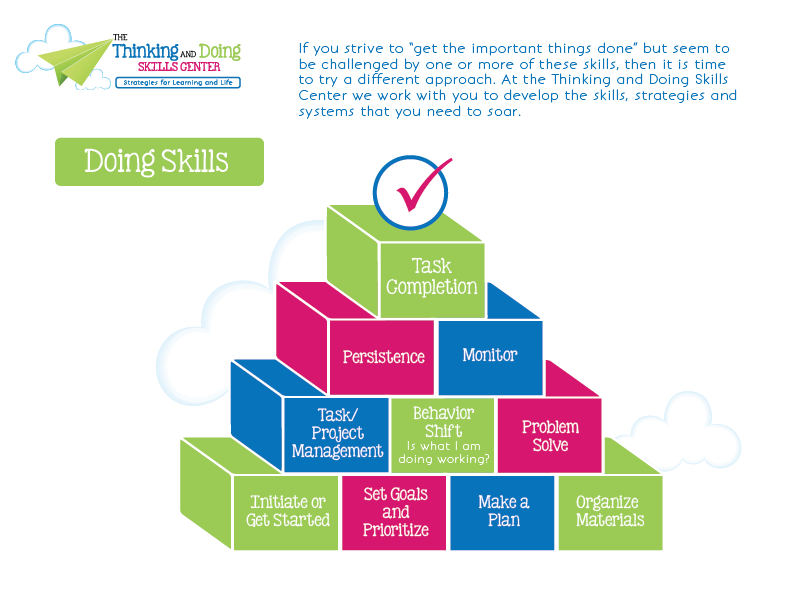
  • Getting started – are you getting the things that need to be done, done?
  • Focus – can you work long enough with enough attention to detail to finish accurately?
  • Inhibit – are you impulsive?
  • Monitor – do you see how your actions affect others?
  • Cognitive flexibility – do you get stuck in your thinking or continue to do things the same way expecting a different result?
  • Working memory – forget what you are doing or how to do it, temporarily?
  • Emotional control – can you control your emotions through frustration, anger, stress, and/or boredom?
  • Metacognition – are you able to think about your thinking?

How do these skills play out in the real world? For adults, it may be about making a good decision, solving a problem in a unique way, or putting information together in a new way that leads to something improved. It is about having a spark of an idea and being able to slowly ignite it into something wonderful. Thinking is what keeps us and the world moving forward. Teaching students how to “think” and solve problems is essential for humanities sake. After all, who knows who will solve the BIG problems the world faces?

Is It a Pineapple or a Banana?

pineapple-150x150Ever wonder why certain things don’t seem to get done? Whether it is the laundry, a report at work, or a project your child is struggling with, there is one major reason. It is because it is a “pineapple!”

Let me explain. If you were hungry and in a hurry as we often are, which fruit would you chose for a snack, a pineapple or a banana? You would probably pick the banana because it is easy to grab and eat, and only takes a second to unwrap before you are enjoying it. The pineapple, on the other hand, has to be peeled, cored and chopped before it is ready to eat. The banana is a “task” and the pineapple is a “project”. Do you see the difference?

This is not my idea but comes from the book, Stop Organizing Start Producing, by Casey Moore. Here’s a link to a video she posted explaining it. Now, if the pineapple was already chopped and ready to eat, which do you think you would pick? The choices are now more equal and you can pick by preference. If the things on your “to do” list are simple, one step tasks, then they are more likely to get done (and it feels so good to cross things off, doesn’t it)? Now if your project was in bite sized pieces do you think you might be more inclined to work on it?

School projects often come with implicit directions and unless your teen is capable of breaking it down into individual steps…..or should I say unless your teen can actually see the project for the multiple steps it really is, then he or she will approach it as a banana when it is really a pineapple. Hence, the all night project marathons. Essays and studying for tests are also pineapples. Help your teen by explaining the difference between a task and a project – or better yet, send them the link to the video.http://youtu.be/OvzG5xmkKjw

Check your task list for pineapples and if you find any, reduce them into their chunks so they are much more easily digestible. If you are unsure how to do this or  would like some support, then join our 4 week Group Coaching Class starting Thursday, April 30th at 7p in Norwell.

5 Key Study Skills for Teens

planner-150x150With all the snow days of the past few weeks, it may be hard for students to remember the information they have previously learned. Here are some basics to pass along to your teen. A great place to start is to take some time to review class notes before heading back to school. Of course,

1. Chunk down the information into manageable pieces and create an outline or a mind map (web) with key concepts as you learn new information and as a review for previously learned material. The brain remembers color, shapes, placement, words and numbers in that order so anytime you can use those things to add to your mind map or notes you are helping your brain remember. Review by covering up a section and repeating. For you auditory learners, you can use a digital recorder or create an mp3 of your notes and play it back.if your teen’s test scores have recently been declining, you may want them to join our Study Skills 2.0 class on February 19, 2015 at 1pm. Register here: http://southshorelearninglab.com/classes/study-skills-2-0/ held at the South Shore Learning Lab, 683 Main Street, Norwell, Ma. (Next class during April vacation week)

2. Study in 30-45 minute blocks and take a 3-5 minute break to allow your brain to process the new information. Then continue.

3. Studying is not about rereading…interact somehow with the information. Ask yourself questions, group facts together, draw a timeline, etc.

4. Don’t cram, it doesn’t work. Space out your studying/reviewing over the week and do a short review of the topics covered each day and then continue on with your homework.

5. Keep good health habits of eating, sleeping and drinking plenty of water (the brain loves it) and also get some exercise – it stirs up the dopamine in your brain which helps it to think. Remember to relax and breathe. If you get stressed your body sends out cortisol the stress hormone and that can shut down your ability to think clearly.

Reviewing in small bites is more effective than cramming and easier to do too. Taking a few extra minutes each day can make a big (actually a HUGE) difference in your grades.

15 Strategies to Get Things Done

AD/HD can effect both children and adults. The true challenge is the amount of impact that it has on someone’s ability to handle life’s responsibilities and that is important to be aware of. The impact may be interfering at home, work, school, or in social situations.  Often it is the executive functioning skills (or central control of the brain) that interferes with a person’s ability to focus, organize, plan, keep emotions under control and/or accomplish tasks.

Executive functions skills are defined as:

The executive functions are a set of processes that all have to do with managing oneself and one’s resources in order to achieve a goal. It is an umbrella term for the neurologically-based skills involving mental control and self-regulation. Taken from:Joyce Cooper-Kahn and Laurie Dietzel (2008) http://www.ldonline.org/article/29122/

Here are just three of the top executive functioning skills and strategies to help handle them. The links are to blog posts I wrote with more information.

1. Task Initiation – or Getting Started

  • Declutter your work space, set up materials you use often in easily accessible places.
  • Get help understanding what is expected (call a friend or coworker).
  • Break it down into smaller pieces and pick one piece to start.
  • Visual timers, alarms, and phone reminders all serve to designate a start time if you use them.
  • Start with the easiest to build momentum.

2. Memory – often called working memory or the ability to hold onto information while using it.

  • Write it down! Use a planner, smartphone app (Google CalendarColor note,EvernoteRemember the MilkHiveminder, etc.), or notepad to keep track
  • Repeat out loud what you want to remember
  • Simplify and slow down. (Multitasking reduces your IQ by 10-20 points, so use your full capacity)
  • Visualize the “end” – what will it look like when I am done/ready?
  • Cut out distractions and focus on the task at hand

3. Action – Inconsistent ability to take action doesn’t occur alone, it often involves other executive functions like, organization, planning, working memory, task initiation, self-regulation, focus and time management. So rather than it being one simple cause, it is often a combination of things that is getting in the way.

  • Make a “must do” list that only includes the top two or three things you must get to
  • Start with the most interesting task first
  • Set false deadlines for yourself or be accountable to someone else for completion
  •  “Suffer” through five minutes – it may motivate enough to keep going
  • Exercise or do something active to increase the dopamine in the brain before beginning (snacks and water help too)

If executive functioning challenges are making it difficult for you or your child to accomplish things then try the above suggestions. Don’t give up too quickly though as it often takes more than the standard 21 days to create a new habit. If you are still looking for some help, contact us for information on our private and group classes. You can also find out more information on the National Resource Center on ADHD website.

Make 2015 Your Year

Only a few days left in January…..if you made a New Year’s resolution or set a new goal, research says you may have given up by now. Has that happened to you? We all start off with good intentions but then somehow we slip back into our “old” ways. Without realizing it our habits take over and by the time we realize it, we’ve slipped.

What if you had a way to interrupt those ingrained habits? You see the problem with trying to do the same thing is that the same problems appear. If it is a new habit we are trying to create then motivation can be hard to find sometimes, or we don’t have what we need, or life interrupts and something else becomes more urgent (notice I didn’t say more important).  Has that ever happened to you? The result is a slow and steady draining of your energy whether you realize it or not.

Without understanding why that resolution or new goal is important to you, you are only seeing the fact that you didn’t do “x”. You are not seeing the big picture of how accomplishing that goal is going to make you feel, or what affect it will have on you and your family. You only see that you didn’t do it. In coaching we say that you are losing sight of the “big agenda” which simply put is who you are becoming. Why did you pick that resolution or goal? Who do you have to become to realize it?

No matter how big your “why” is, you can improve your odds of accomplishing something with a little help from your friends. Well, not really your friends as sometimes they have a tendency to “go easy” on you and let you off the hook if you whine enough about the crazy week you’ve had. You want a coach or accountability partner that will empathize but will also ask you to think deeper about what got in the way and then nonjudgmentally support you and guide you back to your big “why.”

Group coaching is a great way to get that kind of support and accountability. A small group of like-minded women working together to support each other can do amazing things. If you’re ready to make this “your year”, then join our group starting the end of February. Call or email me today as the group is limited to 6 and will be held in the Norwell/Hingham area. (781) 659-0513 or laine@laineslogic.com. Do it for yourself!

How to Remember

The first and most important skill in learning is the ability to remember. If you can’t remember the information you certainly cannot use it for problem solving, creative thinking or critical thinking. The graphic on the left is a representation of the “revised” Bloom’s Taxonomy. The lower green section used to be called “knowledge” when this first came out in the 1950’s. It was revised in the 1990’s and all the nouns were changed to verbs to show that learning is more action oriented. It progresses from the bottom and most basic of skills (remembering) to the top showing the most advanced or higher level thinking skill of creating (called synthesis on the earlier version).

The ability to remember is dependent on a number of factors.  Have you ever forgotten why you entered a room or the name of a person you just met? It could have been due to attention, motivation, emotion or relevancy. These are the same things that affect your son or daughter’s ability to remember also.

FIRST:

  • Get ready to pay attention – this tells the brain to focus on the important and disregard the unimportant.
  • Make sure basic needs are met (food, water, sleep, safety, belonging, etc.)
  • Make sure emotions are in check (emotions control the brain’s ability to remember)
  • What motivates? (intrinsic vs extrinsic)
  • Make learning personal (connect it in a meaningful way to your or your child’s life)

THEN:

  • Manage the distractions – write down anything that interrupts your thinking and deal with it later
  • Visualize what you need to remember (often the crazier the easier to remember)
  • Use color, shape, placement, words and numbers to help the brain recall details (mindmaps)
  • Create mnemonics (riddles, acronyms, acrostics, loci, stories, etc.) for chunks of information
  • Take periodic, non-electronic breaks to allow the brain to process the new information
  • Use your learning style – it’s your preference for a reason
  • Take an interest – read ahead, research on your own, find other sources, make connections
  • Use your own words, rehearse, reflect and review to remember
  • Maintain a growth mindset – believe you can remember/learn anything. It’s effort not IQ.

Whether it is in the classroom, boardroom or living room, your ability to remember starts when you are first presented with new/different information – be ready.

5 Things Your Child Needs to Know Before School Starts

1. New Beginnings: First and foremost students need to understand that each year is a brand new start. Yes, it is easy to fall back into old habits but if last year did not go the way you or your child wanted it to,  (due to the various pandemic learning situations) then you both have the opportunity to start fresh. A self-fulfilling prophecy has been defined by www.businessdirectory.com as, “Any positive or negative expectation about circumstances, events, or people that may affect a person’s behavior toward them in a manner that causes those expectations to be fulfilled. In other words, causing something to happen by believing it will come true.”

This is not what we want to see happen. Thinking about your approach to homework difficulties before they arise and being aware of what caused you and/or them to get frustrated is a good start. What else was going on at the time? Did you find you were trying to rush your tween/teen to keep them moving on your own schedule? Were they so involved in after school programs that they “ran” from one thing to the next with no time to themselves? Were your expectations really realistic? Or were you just assuming that it, “shouldn’t take that long?” Your child is NOT you. They need above all else to know they are loved and that this year is truly a new beginning.

2. Mindset: Kids also need to know they are capable of doing anything they put their minds to. It is okay to fail provided they learn from that and figure out what to do to improve. The learning is more important than the grade. Let me repeat that, the learning is more important than the grade (suggested reading Carol Dweck, Mindset)

3. Job Requirements: Children need to remember that school is their “job.” As a job there are certain responsibilities just like any other job. You are required to do the work, put in your best effort, manage your time and your attention so that you can get your work done and still have time to yourself. No one should “work” a 12 hour day. FYI: Homework does not need to be perfect. The teacher needs to know what your child really knows and is capable of on their own, versus what they assume when they see a perfectly neat, correct homework that the two of you spent hours on.

4. What’s up? Each week everyone in the family needs to know what is up and what might interfere with homework time. Try to not schedule dentist appts or one-time events into their week without giving them notice. If something is scheduled like an organization class each week, have them block it out in their agenda and set a reminder on their phone. Sunday family meetings are a great way to start the week. Everyone knows what is happening that week and there are no surprises. Remember how it feels when your boss throws something at you unexpectedly?

Also decide together what time homework will start. Allow a 20-30 minute break when coming home. Take a 5 minute active, non-electronic break in between subjects. Keep an analog clock within view. Read the directions and picture what the finished homework will look like and then begin.

5. The basics: the school layout and where key places are such as: locker (and the combination), bathrooms on each floor, classrooms (and the quickest path to each), office and lunch room. Know the rules about cell phone use and iPods. Listen for teacher expectations like the homework rules, (late policy) where to find HW information (back board, online portal, does it get passed in or corrected together, etc.), test days, gym days, and any other information that can easily be assumed they “should” know but may not.

It’s a new beginning for students, parents and teachers too. This is your opportunity to set the expectations before problems begin and have a plan of action before it is needed. No homework is worth the stress that it can create. The relationship comes first.

10 Ways to Shake Things Up and Build Your Brain Too

pail and shovel beachAugust is known as the back to school month. It is usually a month of anticipation and anxiety. Parents are out purchasing school supplies and clothes for kids that are both excited and nervous about the new school year. College students are getting ready to head to school this month and so you may notice a bit of an “attitude”. It is really just their excitement and anxiety building as they try to define their evolving relationship with mom and dad. What about you? How do you feel now that the summer is coming to an end?

If you have kids then the switch back into the school calendar is a jolt to your child’s routine. It is smart to start “practicing” some skills now before the mad rush begins. Maybe you start working the bedtime back, insist they get dressed before coming downstairs, have them lay out their clothes the night before….all simple things that will help create positive habits for the school year. What new habit would you like to create that will make your life better? You can’t expect this year to be any different if you don’t DO anything different.

The fall is a great time to take an evening course, pick up a new hobby or sign up for an exercise class with a friend. Check out what is available in your area and fits your schedule. Stepping out of your comfort zone and learning something new is a great way to keep your mind active. It builds new brain synapses (or connections) and that’s a good thing. Changing up the daily routine helps too. Here are some ideas to shake things up a bit.

  1. Take a different route to/from work (maybe stop at the beach for some quiet time before heading home).
  2. Eat with your non dominant hand (it will slow down your eating and make you more mindful).
  3. Change up your morning routine and turn off the auto pilot
  4. Go to bed earlier
  5. Watch less TV (or make one or two days TV free)
  6. Shut down electronics an hour before bed (the blue light they give off messes with your sleep hormones)
  7. Get up and move every ½ hour for at least two minutes during your workday. Better yet walk for 30 – 45 minutes every day. Wear a pedometer and try to beat each day’s steps.
  8. Learn something new or challenge yourself in some way. New recipe? New language? New hobby? New vegetable?
  9. Check email only three times a day (unless it is work related) and never before your first “to do” is done.
  10. Use a planner or calendar app to actually plan out the night before the top 3-5 things you will accomplish tomorrow. Start each day fresh; don’t just move items to the next day. Pick the things that you really want/need to get done.

We often become so programmed that we are on autopilot throughout a large portion of our day. There’s one month left to the summer, make the most of it and “shake” things up. Your brain (and probably your family) will thank you.

This is from the Laine’s Logic Newsletter Archives. If you would like to get our monthly newsletter, you can sign up here: http://www.laineslogic.com/children

What is the “Common Core” and What Does it Mean for my Teen?

blooms-taxonomy-2In the United States, 43 of the states have adopted the common core and Massachusetts is one of them. That means that teachers and other experts put together age appropriate standards for the common knowledge (skill set) they feel would prepare a high school senior for college and/or entering the work force upon graduation.  Here’s a three minute video that explains more.

In order to test a student’s progress towards that goal, they have designed a new test called the PARCC. Last year many students were asked to “beta” test it and it is expected to replace MCAS this year. The difference is that the PARCC test requires students to problem solve and think critically to use what they have learned, rather than answering simple basic knowledge questions. Click on the link to see an example of a PARCC question for a sixth grader.

So, what is the big deal? Unfortunately, we’ve been asking students to memorize facts rather than to use that information in a productive manner. Teachers have been focusing on the low level thinking skills of memorizing facts (as that was what MCAS focused on) and handing out “study guides” encouraging students to become passive learners rather than active learners. Fast forward to college and it is no surprise students struggle with knowing HOW to study (no study guides here), problem solve, or plan, organize and complete a project.

What to watch for:

  • Last minute projects
  • Short study sessions
  • Poor test grades
  • Difficulty doing homework that requires thinking deeper(or taxes the working memory)
  • Misunderstanding words like, “evaluate, analyze, synthesize, and demonstrate.”

What can you do now to help?

  • Think aloud as you problem solve and encourage your son or daughter to weigh in and support their perspective.
  • Allow “think time” when your teen is stuck with a problem or a decision (don’t provide the solution)
  • Ask questions that require more than a simple “yes” or “no” or one word response.
  • Start with the end in mind….ask, “What will the homework, trip to the mall, or project look like when finished?” Then help your teen work backwards to make an effective plan and problem solve before attempting.
  • Ask questions that encourage critical thinking:
    • “What are the pros and cons of choosing…..?”
    • “What is your opinion about…?”
    • “How would you plan to……?”
    • “What would you predict….?”
    • “How has your thinking changed on…?”
    • “How would you approach this problem?”

Developing thinking skills will help your teen make better decisions, problem solve and communicate their thoughts more logically both at school and in life.

More info on PARCC test items for your son or daughter’s grade level can be found here: http://www.parcconline.org/samples/item-task-prototypes.

Contact us for help with thinking skills and study skills. We specialize in the thinking and doing skills for learning and life.