Choices, Choices, Choices

CEleanor-Roosevelt-In-the-long-runhoices….choices are all around us. We make choices consciously and unconsciously all day long. From the
moment we wake up we are making choices about, what to wear, what to eat, where to pick up coffee, which priority to work on at work. Not to mention the choices in the media, on FaceBook, at the grocery store, etc. We are literally bombarded by choices.

What if you could reduce the number of choices you have to make? You would free up working memory space that just might help you make a better decision about something that is important to you. When your working memory is full (it can only hold so much), it lets go of information. We have no control really of what it lets go of. This is also why teens often think they have studied enough, but end up not getting the grades they are capable of.

If we look at all the choices we have we can suffer from decision paralysis, or making the quickest or easiest decision but not necessarily the “best” or “most right” decision for ourselves. Have you ever made a decision/choice that you later regretted or wished you had thought about longer? Is your willpower being drained? Are you moving in the direction of your dreams or are your ever-changing choices getting in the way?

Then it is time to discover your “non-negotiables.” Non-negotiables are those choices/decisions you have made ahead of time and will stick to. You no longer have to even think about them. It is easiest, according to Darren Hardy of Success magazine to start with the things you won’t tolerate or do. Make the decision/choice now before you need it and you can focus on the more important choices. If you made a New Year’s Resolution this year to lose weight for example, and have already given up, then maybe it’s time for a non-negotiable choice of no cookies or 30 minutes of movement a day, or make bedtime a non-negotiable, or being late a non-negotiable. You get the idea, think of how it would change your life and eliminate the drain on your will power. Isn’t time you kept those promises you make to yourself?

Think about how having non-negotiable decisions made ahead of time could effect your teen. What if not completing homework was just non-negotiable? Or studying for at least an hour was “non-negotiable?” You get the idea….we could all benefit from having some non-negotiables before we are faced with another choice.

What is Executive Function?

Thinking skill posterExecutive dysfunction or executive function deficit is defined by Web MD as a “set of mental skills that help you get things done.” It is a simplified definition but when you break a task down into all the components needed to complete it, it is easier to see how having one or more weak areas can stop the progress. Just take a look at the processes and skills that are needed for “thinking” in the graphic to the left. That does not take into account the other skills needed to actually get something done. These executive function skills develop in the prefrontal cortex of the brain which continues to develop until around age 25. However, these skills seem to be really important during the teen age years, yet are not quite developed enough to be depended upon.

Executive function skills help you:

  • Manage time and be realistic about what you can and cannot do in the time available
  • Regulate your emotions and behaviors to avoid saying or doing the wrong thing
  • Determine what you should pay attention to and what you should not
  • Switch focus based on the feedback you receive about the effectiveness of what you are doing
  • Plan and organize in a logical, methodical way to complete tasks and thoughts.
  • Remember what you need to remember at the right time
  • Allows you to make decisions based on your past experiences and avoid repeating your mistakes

In school, executive dysfunction can look like missing homework, forgetting to study for tests, doing poorly, spending hours on homework, or not being able to find things they know they have. One thing executive dysfunction is not, is the attitude of not caring. Most students really do care and cannot understand why they can’t “remember” things. They are frustrated and feel less capable than their peers. Self-esteem suffers and unless they get some help they can spend their school years continuing to do things the same way….and getting the same (lower than they are capable of) grades.

The worst part is that they may continue to think that they are not “smart” and avoid opportunities to stretch themselves for the rest of their lives.

What’s a parent to do? We often try to “show” our children how they “should” do things, or we wonder out loud how they could have done…x, y or z (how could you…what were you thinking…why didn’t you….etc). Although well meaning, these approaches are often met with resistance and your teen may internalize the guilt and judgment that you didn’t realize came across.

It’s time to take you out of the picture. Get students to take a deeper look at what is happening and then coach them to design strategies to work for the way they think. Traditional methods often do not work because the habits are not built into them. Teens are “told” what to do and often do not take the time to think about whether it works for them or not.

The most common executive skills that affect academics are:

  • planning/organizing thoughts, ideas and processes – difficulty writing essays in a thoughtful, organized manner, or completing projects, developing a study plan
  • working memory – holding onto all the information needed
  • cognitive flexibility- ability to shift thinking and or behavior when stuck
  • focus – determine what to focus on and what to ignore
  • controlling emotions – keeping them in check even when frustration builds
  • taking action – doing what you know needs to be done
  • getting started – taking the first step is often the toughest
  • task completion

If your teen struggles with any of these skills, it may be time to try coaching. Coaches believe that individuals have all the skills and knowledge they need to solve their own challenges by guiding them to think deeper and more creatively about them through guided questions. Teens often don’t take the time or feel they have the power to make changes that will work for the way they think. Isn’t it time they took back that power? Our group coaching classes help students become proactive, design strategies and test them, and learn about how they think with a small group of like-minded peers.

The Busyness of Back to School – Five Steps to Calm the “Crazy”

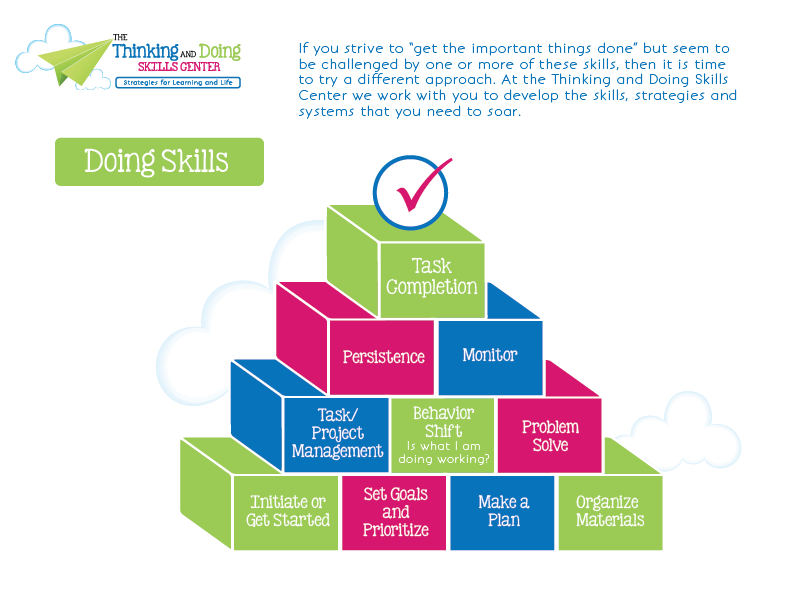
Doing skill posterSo much to do, so little time…..I hope that is not what you are thinking as we reach the end of August. It is a busy month for sure and often the transition from summer to “school” can make the new situation seem even more challenging. Here are five things to think about to make this year more manageable, less stressful and not quite as “crazy” as last year.

  1. Each school year is a new start. Although each grade comes with its own challenges, it also comes with its own rewards. Major transitions are in first, fourth, six (or whatever grade your middle school starts at) and 9th grade. If it’s a new school, take time to tour it and find the bathrooms, locker, lunch room and office. Notice when your child is struggling – is it a lack of understanding, frustration, distraction or boredom? It’s a new start for you as well. Set yourself a goal of making this a calmer, more organized year and notice what is getting in the way. This year fix it so that tomorrow is better than today.
  2. Don’t overbook. Children need time to play and be outdoors and they can’t do that if they are overbooked and running from one activity to another. Make choices and remember homework should not be an afterthought. Don’t expect your child to have any energy left for homework if they are going all day long. They have a right to some “free” time too and need it to recharge, so make sure homework doesn’t use up all available time. Sleep 8+ hours is best. Remember your role in extra curricula activities, are you the pick up or drop off person? What does that mean for your schedule and for the family’s evening?
  3. Get organized! This is probably the most important thing you can do for yourself and your family. When the morning runs smoothly, the day goes better too. It’s important to have routines and habits that serve you and the family like a morning routine, an evening routine that includes getting ready for the next day, a regular shopping day or at least a meal plan so you know what is for dinner each night. Having a family meeting helps everyone know what is up for the week with extra curricula activities and/or appointments.
  4. Prepare for the week ahead. Everybody knows that having clean clothes makes getting dressed easier. Same goes for having a clean and organized backpack, it makes the homework go easier. Take the time to prepare what you can for the week ahead. Some ideas are laundry done, snacks and food choices, rooms picked up and backpacks organized. Use a planner whether it is digital or paper doesn’t matter but the pace of your life means you shouldn’t rely on your memory without some backup. Use the reminder app on your phone for really important things.
  5. Lastly, if your child has ADHD or Executive functioning challenges, then no amount of coaxing, rewarding, threatening or seizing of things they hold dear, is going to help them get their work done any faster or better. Imagine what it would be like if they understood what was getting in the way of their success and had some strategies that they could use to push through the homework. You have the power to make this year better for the entire family by helping them develop the strategies and understanding they need to be successful. We can help too.

Just Get Started – From the Archives

doingskills_NO-BARWith the start of the new school year, I thought it was important to revisit the art of getting started previously published on our blog in 2013.

The ability to get started on something is called “task initiation or activation” by the experts on Executive functions (Russell Barkley, Peg Dawson, Thomas Brown, etc). Executive functions are those skills that help us get things done.  Task initiation is just one of these executive skills and it involves the ability to START. Difficulties getting started can be the result of not knowing where to begin, what to do, how to generate ideas or how to problem solve to move forward on something. It differs from procrastination in that it is often not deliberate avoidance but a lack of understanding in knowing what to do to start. It can also show up as a difficulty with transitioning from one activity to another.

In children and teens, task initiation may show up as:

  • Difficulty getting started on homework
  • Struggles with generating ideas for writing
  • Problems with morning and evening routines (often needing excessive prompting to be ready for school)
  • Procrastination or being seen as unmotivated

In adults:

  • Procrastination followed by hyperfocus to meet deadlines
  • Projects that never get started
  • Unpaid or late bills, missed deadlines, and feelings of guilt

Removing the roadblocks:

  1. Is the environment getting in the way?

If your space is cluttered or you can’t find what you need to get going on something then it is time to take care of that. You end up expending more energy just looking for what you need to get started that by the time you do that, you don’t have the energy or inclination to continue. Declutter your work space, set up materials you use often in easily accessible places. Rulers, scissors, pens and pencils fit nicely in a mug on the desk. Set up colored plastic folders or boxes to hold all pieces of an ongoing project. Take everything out of the backpack and pile the “to do” items on the left and as you complete them move them to the right.

  1. Are you not sure what to do?
  • Get help understanding what is expected (call a friend or coworker).
  • Break it down into smaller pieces and pick one piece to start.
  • Work with a friend (use them as a body double to get you started).
  • Have someone tell you what to work on.
  • Use a graphic organizer.

Start with the end in mind. Sketch out what it will look like when completed and work backwards to determine the first few steps.

  1. Nudges, pokes and jabs:
  • Visual timers, alarms, and phone reminders all serve to designate a start time if you use them.
  • Set the sleep timer or automatic shut off on your TV, or use ifocusonwork.com to help shut down other distractions so you can get started on the important things.
  • Set false deadlines for yourself or have someone else set them for you.
  • Put your cellphone in another room and don’t check it until you have worked 30 minutes. Use a timer here so you are not constantly checking how much time has passed.
  • Make a deal with someone that you know has your best interests at heart and ask them to help you get started.
  1. Routines
  • Create a basic week plan so that you know what day you will do what.
  • Students set up a routine for your homework with a break, snack and start time. Then work for 30-45 minutes before taking another break.
  • Start with the easiest to build momentum.
  • Meet your friends at the library to do homework together.
  • Create a mnemonic that helps you get ready to begin and use it daily.
  • Create a play list for the length of time before you need to start and use it daily. The more you listen to it, the more your body and brain will get the message that it is time to get to work as soon as this is over.
  1. If you still can’t….
  • Just start, after about ten minutes you will get into it.
  • Create a mind map or draw out what you need to do. Use colors and shapes to help your brain remember them and pick one.
  • If you are really procrastinating on something, stop and consider, “What is the worst that could happen if I didn’t do this? If it’s not too serious, then let it go or delegate it.

Often times looming deadlines, promises to others and fear of failure will push adults to complete a task they have been putting off. Many students though are not motivated by deadlines, grades or loss of privileges. They need help in learning what is preventing them from getting started and help designing a strategy that will work for them. Our group classes can help them find the strategies that will work for the way they think. Next classes start Oct 7 and 8th.

15 Strategies to Get Things Done

AD/HD can effect both children and adults. The true challenge is the amount of impact that it has on someone’s ability to handle life’s responsibilities and that is important to be aware of. The impact may be interfering at home, work, school, or in social situations.  Often it is the executive functioning skills (or central control of the brain) that interferes with a person’s ability to focus, organize, plan, keep emotions under control and/or accomplish tasks.

Executive functions skills are defined as:

The executive functions are a set of processes that all have to do with managing oneself and one’s resources in order to achieve a goal. It is an umbrella term for the neurologically-based skills involving mental control and self-regulation. Taken from:Joyce Cooper-Kahn and Laurie Dietzel (2008) http://www.ldonline.org/article/29122/

Here are just three of the top executive functioning skills and strategies to help handle them. The links are to blog posts I wrote with more information.

1. Task Initiation – or Getting Started

  • Declutter your work space, set up materials you use often in easily accessible places.
  • Get help understanding what is expected (call a friend or coworker).
  • Break it down into smaller pieces and pick one piece to start.
  • Visual timers, alarms, and phone reminders all serve to designate a start time if you use them.
  • Start with the easiest to build momentum.

2. Memory – often called working memory or the ability to hold onto information while using it.

  • Write it down! Use a planner, smartphone app (Google Calendar, Color note,Evernote, Remember the Milk, Hiveminder, etc.), or notepad to keep track
  • Repeat out loud what you want to remember
  • Simplify and slow down. (Multitasking reduces your IQ by 10-20 points, so use your full capacity)
  • Visualize the “end” – what will it look like when I am done/ready?
  • Cut out distractions and focus on the task at hand

3. Action – Inconsistent ability to take action doesn’t occur alone, it often involves other executive functions like, organization, planning, working memory, task initiation, self-regulation, focus and time management. So rather than it being one simple cause, it is often a combination of things that is getting in the way.

  • Make a “must do” list that only includes the top two or three things you must get to
  • Start with the most interesting task first
  • Set false deadlines for yourself or be accountable to someone else for completion
  •  “Suffer” through five minutes – it may motivate enough to keep going
  • Exercise or do something active to increase the dopamine in the brain before beginning (snacks and water help too)

If executive functioning challenges are making it difficult for you or your child to accomplish things then try the above suggestions. Don’t give up too quickly though as it often takes more than the standard 21 days to create a new habit. If you are still looking for some help, contact us for information on our private and group classes. You can also find out more information on the National Resource Center on ADHD website.

The Art of the Master To Do List

There once was a Mama Bear who felt like she was part “day planner.”  Every day she would go through the calendar and the to do list. She would gently remind the little bears what activities they had or what they needed to “get done” and also prompt the papa bear of what he needed to remember too. Often the Mama Bear would mention a task or problem that needed fixing, and unless it was urgent, or papa bear had free time at that moment….it often went undone. This continued for years until the Mama Bear realized she was doing all the remembering and everyone was depending on her to think for them and still things were not getting done.

So, Mama Bear, being the “organized” one decided to teach the big bear and the little bears how to keep track of things with a master to do list. Here’s what I learned from her:

  • Create a list of all the tasks you want to remember. Often our brain will wake us up in the middle of the night because it does not want us to forget something. This is commonly called a “brain dump.” Don’t let your to do’s keep you up.
  • Put everything on it, even that project you “hope” to get to someday but make sure that it is in the form of the smallest action you can take. Redo the dining room is too big of a project, so you should write down the steps that are involved. (Helpful apps: color note, Evernote, Hiveminder, etc.)
  • Write down any deadlines or due dates and be sure to highlight those things that need to be done in the current month.
  • Don’t get alarmed! All this stuff was floating around in your head anyway and probably draining your energy. You should feel relieved that nothing has “fallen through the cracks.”
  • Decide what needs to be done and/or what you would like to get done this week or this month.
  • Estimate how long those things will take – be realistic.
  • Pick the three top things you want or must do (given the amount of time you have in your day)
  • Now either add them into specific dates on your calendar or set aside a “block” of time (preferably each week) that you will tackle tasks on this list.
  • Each week as you are planning pick the tasks off of the master list to add to your week or your time slot. Don’t cross them off your master to do list unless you ACTUALLY complete them.
  • Celebrate your successes. Remember you will always have a list – just make sure it has what is important to you. Life will get in the way….so start each day fresh and don’t carry things over from the previous day unless you really want to.

Papa Bear now has his own master list, and he and Mama Bear discuss the upcoming week (and the to dos) each Sunday over breakfast. And that makes Mama Bear happy!

Work to Home – 7 Strategies for a Smooth Transition


Clock Reading Five O’Clock

What happens in that space between leaving work and stepping in the door at home? Are you able to shut off work and quickly transition to the dog, kids, and dinner or do you feel more like the two halves of your brain are constantly competing for attention?

Creating a time and/or space for yourself to transition from work to home can help you feel more balanced and under control. Here are seven strategies that can help you make a smoother transition from work to home.

1. Create boundaries around your time. Decide on your quitting time. If you are at work outside of the home it could be about leaving at 5pm. If you are at home, it could be whatever time the kids get home from school. Pick whatever time works for you that allows you to physically and mentally leave your work behind.

2. Set a routine for leaving work that allows you to clear your mind and prepare for the next day. Use sticky notes to remind you of the next action on that project. Set an alarm to remind you 30 minutes ahead of time so you can tie up any loose ends and set yourself up for tomorrow. Even if you work from home or are “at home” you can create a routine that allows you to put away the work side and focus on the family side. Kids transition through bath time, story time or certain night time routines. You can use their transition to set up your own special routine or start yours after they are in bed.

3. Get comfy by switching into stay at home clothes on the days that you can. This tells your brain you are home for the evening.

4. Make an evening plan for yourself. Is there something you would like to get done? Use your child’s homework time as your time to get some paperwork handled or send emails. The kids see that you are available but you are not distracting.

5. Plan tomorrow – what will you wear, what will you eat, what do you need to take with you and what one thing can you do either on your way home or during your lunch that will make you feel good?

6. Get everyone in the family to share one thing that is the best, worst or funniest of their day

7. Lastly, take some time for yourself! What simple thing can you do for yourself that will bring you that sense of pleasure? Turn off the TV, skim that magazine, read that book or have a conversation with your spouse over a glass of ________.

Whatever you do, making a concentrated effort to give yourself some time to make that transition from work and the stress of the commute home to your family will benefit all.

Lights! Camera!…..ACTION! 15 Steps to Get Going

frustrated studentTaking action and following through on something that has to be done is often difficult for those with ADHD or Executive Functioning challenges. In most cases, students and adults understand the importance of completing something but find it difficult to actually “move themselves” to action. What is happening in the brain, in my understanding, is that the level of dopamine is not sufficient to reliably carry messages/signals from one side of the brain to the other or to provide enough motivation for action. That makes this difficulty neurobiological and not motivational. There is a big difference there as often we have seen things get completed before and feel that if it can be done once why not every time? Such is life with ADHD and/or Executive Dysfunction. Inconsistent ability to take action doesn’t occur alone, it often involves other executive functions like, organization, planning, working memory, task initiation, self-regulation, focus and time management. So rather than it being one simple cause, it is often a combination of things that is getting in the way. Also not learning from previous experiences plays into why this same thing continues to happen over and over again. If possible try to break it down to see what is really getting in the way and work on one piece of the puzzle at a time.

Here’s what it may look like in students:

Inconsistent ability to complete homework regularly (or long hours spent doing it)
Last minute approach to long term projects
Being late or last minute
May look like a lack of motivation, not caring, or teen age “attitude”
Failing tests due to inability to study enough (or up past midnight studying)

In adults:

Often late (but only by a little bit) or last minute on meeting important deadlines
Procrastination and/or lack of follow through
High energy and always appear to be very busy without actually accomplishing a lot.
“Paralyzed” when they don’t know how to do something or don’t want to do it
Inability to prioritize

Here’s what can help:

    1. Make a “must do” list that only includes the top two or three things you must get to
    2. Start with the most interesting task first
    3. Set false deadlines for yourself or be accountable to someone else for completion
    4. Break it down into manageable size actionable steps and use verbs for each step
    5. Set goals and behavior contracts weekly with students (too far in advance is worthless)
    6. Act as a body double for your student by being close by during homework time and doing your “homework”
    7. Teach your child to “talk to themselves” and ask questions to keep themselves on track
    8. Support them or provide supports for them but don’t do it for them
    9. Keep the end in mind – what will the homework look like when completed and what will I do after it is?
    10. “Suffer” through five minutes – it may motivate enough to keep going
    11. Exercise or do something active to increase the dopamine in the brain before beginning (snacks and water help too)
    12. Remind yourself and/or your student of past successes
    13. Change the environment, change the task or change the expectations
    14. Use timers and allow five minute breaks for every 30 minutes of work (minimize distractions)
    15. Use plenty of positive reinforcement that mentions specific actions you see your child doing

Motivating someone else or even yourself to take action often depends on how important the task seems (that adrenaline rush is actually raising the dopamine levels too). If someone else (usually your kids or spouse) is waiting on you to do something you may be more likely to do it. In school, students can often “force” themselves to get something done for a favorite teacher or subject but may feel it is torturous for their least favorite. Start small and put checklists, timers, notes to self (especially where you leave off on a project) and use the steps above that help. Having something to look forward to can often provide an extra push so be sure to reward yourself and/or your child. Now, get going!

Hocus Pocus Focus!

fairyThe ability to focus or to sustain attention involves ignoring distractions and continuing to work even though the task may be boring, tiring or frustrating. This executive function, often called sustained attention, may be impacted by other challenges such as auditory or visual processing problems, working memory challenges or the inability to shift current thought processes when becoming stuck on something. Adults are constantly monitoring themselves and even if distracted by some external cause are often able to get themselves back on track and get the task completed (if it is important to them). Children have much shorter attention spans (they develop as the child grows) and may find it difficult to “push” through to completion.

In children and teens, sustained attention challenges may look like:

  • Taking hours to complete simple homework assignments
  • Incomplete assignments (skipped problems, hurried work, etc.)
  • Jumping from one thing to another
  • Problems with friends due to misunderstandings from not really “hearing” what was said
  • Failure to notice when what they are doing isn’t working and an inability to switch their approach

In adults:

  • Unfinished projects, missed deadlines, incomplete work
  • Extra time needed for tasks (due to distractibility)
  • Multitasking without actually completing anything or completing the less important but more interesting task
  • Difficulty getting through a multistep process

Removing the roadblocks:

1. Distractions can be visual, auditory or cognitive:

  • Clear the clutter or move to another space and be sure to have everything you need before beginning.
  • Work at the library.
  •  Use a tri fold foam board that has been cut in half to create a “focus place” for your child. Add visual reminders.
  • Use noise cancelling headphones or play “focus” music or classical music or white noise. Create a 30 minute play list and allow breaks if they work until the music ends.
  • Keep a notepad nearby and write down any thoughts that interrupt.
  • Keep a beverage and snacks within reach so your body won’t interrupt you.
  • If you still notice difficulty in focusing, set your phone to vibrate or use a motivaider to periodically force you to check that you are on task

2. Start with the end in mind:

  • Picture the end product and then work backwards to determine the steps involved.
  • Have students create a schedule with time estimates for homework and visualize (or sketch out) the finished product.
  • Help your child use their preferred learning style whenever possible.
  • What will be the reward for finishing? Make it motivating!

3. Break it down into smaller parts:

  • Divide the task or homework into bite sized steps so that at least one step can be completed before taking a short break.
  • If you leave a task unfinished, write a note that reminds you of the next step so you can get quickly back to it.
  • Try to determine the length of your child’s attention span and slowly push them to increase it – do the same for yourself.
  • Start with the most challenging piece first and get it over with unless your child needs time to “warm up” to working.

4. Provide incentives:

  • Check in frequently with a positive comment or words of encouragement (no nagging allowed)
  • Use a reward system that motivates.
  • Make the task interesting by making it a game or fun challenge.
  • Provide active breaks

5. Make time visual:

  • Use a visual time timer or have an analog clock within sight.
  • Use a clock with a glass face to highlight with dry erase markers, the homework schedule. Sarah Ward suggests using different colors to block off each subject (great for an hour or less at a time).
  • Online timers work for those using computers. Try Cinnamon software for a talking alarm clock or ifocusonwork.com to keep you on track and off of Facebook.

The ability to maintain attention long enough to get information, or complete a task is important whether you are a student or an adult. Noticing what is getting in the way and dealing with it will go a long way towards increasing your attention and getting things done.

Just Get Started!

procrastination-fortune-cookie-500x300The ability to get started on something is called “task initiation or activation” by the experts on Executive functions (Russell Barkley, Peg Dawson, Thomas Brown, etc). Executive functions are those skills that help us get things done.  Task initiation is just one of these executive skills and it involves the ability to START. Difficulties getting started can be the result of not knowing where to begin, what to do, how to generate ideas or how to problem solve to move forward on something. It differs from procrastination in that it is often not deliberate avoidance but a lack of understanding in knowing what to do to start. It can also show up as a difficulty with transitioning from one activity to another.

In children and teens, task initiation may show up as:

  • Difficulty getting started on homework
  • Struggles with generating ideas for writing
  • Problems with morning and evening routines (often needing excessive prompting to be ready for school)
  • Procrastination or being seen as unmotivated

In adults:

  • Procrastination followed by hyperfocus to meet deadlines
  • Projects that never get started
  • Unpaid or late bills, missed deadlines, and feelings of guilt

Removing the roadblocks:

1. Is the environment getting in the way?

If your space is cluttered or you can’t find what you need to get going on something then it is time to take care of that. You end up expending more energy just looking for what you need to get started that by the time you do that, you don’t have the energy or inclination to continue.
Declutter your work space, set up materials you use often in easily accessible places. Rulers, scissors, pens and pencils fit nicely in a mug on the desk.
Set up colored plastic folders or boxes to hold all pieces of an ongoing project.
Take everything out of the backpack and pile the “to do” items on the left and as you complete them move them to the right.

2.  Are you not sure what to do?

Get help understanding what is expected (call a friend or coworker).
Break it down into smaller pieces and pick one piece to start.
Work with a friend (use them as a body double to get you started).
Have someone tell you what to work on.
Use a graphic organizer.
Start with the end in mind. Sketch out what it will look like when completed and work backwards to determine the first few steps. 

3. Nudges, pokes and jabs:

Visual timers, alarms, and phone reminders all serve to designate a start time if you use them.
Set the sleep timer or automatic shut off on your TV, or use ifocusonwork.com to help shut down other distractions so you can get started on the important things.
Set false deadlines for yourself or have someone else set them for you. Put your cellphone in another room and don’t check it until you have worked 30 minutes. Use a timer here so you are not constantly checking how much time has passed. 
Make a deal with someone that you know has your best interests at heart and ask them to help you get started.

 4. Routines

Create a basic week plan so that you know what day you will do what.
Students set up a routine for your homework with a break, snack and start time. Then work for 30-45 minutes before taking another break.
Start with the easiest to build momentum.
Meet your friends at the library to do homework together.
Create a mnemonic that helps you get ready to begin and use it daily.
Create a play list for the length of time before you need to start and use it daily. The more you listen to it, the more your body and brain will get the message that it is time to get to work as soon as this is over.

5. If you still can’t….

Just start, after about ten minutes you will get into it.
Create a mind map or draw out what you need to do. Use colors and shapes to help your brain remember them and pick one.
If you are really procrastinating on something, stop and consider, “What is the worst that could happen if I don’t do this?” If it’s not too serious, then let it go or delegate it. 

Often times looming deadlines, promises to others and fear of failure will push adults to complete a task they have been putting off. Many students though are not motivated by deadlines, grades or loss of privileges. They need help in learning what is preventing them from getting started and help designing a strategy that will work for them.