Helping or Hurting? The Dilemma of Enabling vs. Empowering

groupphotoWe all want our children to grow up to be responsible, successful members of society. Isn’t that what you want for your child? So we “help” them at every turn so that they can make it to school on time, complete their homework perfectly, and get good grades. But are you really helping or are you hurting them?

Let me explain. If your child or teen has ADHD/ADD then you know that they struggle with routines, focus and remembering what they need to do as well as, doing what they know they need to do. You may feel that if you don’t remind your teen then they would never get out the door in the morning or finish their homework. And you may be right. However, providing them with the information they need before they have had time to consider what comes next does not help them develop the necessary skills to become independent instead it makes them dependent.

Think about these questions:

  1. Are you helping your son or daughter create a routine to get out the door (with everything they need) or are you telling them what to do each day? (Ex. get your shoes on, did you brush your teeth, do you have your homework? And on and on.)
  2. Are you empathizing and really trying to understand what they are feeling or are you just trying to solve their problem by telling them what they “should” do?
  3. Are you checking their homework and making them correct it so that the teacher doesn’t know that they are struggling with it?
  4. Are you reminding them of everything they have to do so that they don’t have to remember on their own?
  5. Are you waking them up in the morning?

If you answered “yes” to even one of these questions, please keep reading because although you may think you are helping your children, in reality you are not. When you take away your child’s opportunity to problem solve by either telling them what they should do, or by doing it for them, not only do you handicap them from learning the skills but you are chipping away at their self-esteem and self-confidence and fostering their dependence rather than independence.

For those with ADHD, learning routines and habits can take a bit longer than it does for those without ADHD. So it is important to start building the skills early so that by the time they get to high school, you have done your job and your teen is pretty independent. You want to feel confident that they can make it on their own at college. On the other hand, if you wait until they are a senior to start “letting go” and just drop the support you have been providing all along, they may not have the skills they need to succeed in college.

So, how can you empower them instead?

  1. Work on one thing at a time. Together decide what it will be. Empower your teen to come up with their own solutions just be sure to include how they want you to “support” them in this new process.
  2. Instead of saying you “should”…..try asking questions that lead to your teen figuring out their own solutions. Ex. “What do you think you could do to figure that out?” “How can you prevent that from happening again?”
  3. Learn about Executive Function skills so that you and your teen can better pinpoint which skill is weak. Is it getting started on things (task initiation), remembering (working memory) or finishing things (task completion) etc.? Weaknesses can occur in several executive functions but often there are EFs that are strengths as well. What looks like several areas of weakness could be the same EF showing up in a different context. How can you use the strengths to help compensate for the weaknesses?
  4. Change comes from within but here are three questions to ask that can help. Can the environment be changed to better accommodate for the weakness? Can the task be broken down into more manageable steps so that it is not so overwhelming? Does there need to be a system or a routine created to assist in solving this?
  5. Lastly, consider whether or not you are too close to the situation to really be able to help, or if you are finding it difficult to remain nonjudgmental then it may be time to find an Executive function coach or counselor to work with your teen. An EF coach will work with your teen to identify those weak EFs and together they will develop a plan/strategy to strengthen them and the coach will hold your teen accountable for taking action on that plan and meeting the goals that are set.

Jodi Sleeper-Triplett said this in her book Empowering Youth with ADHD:

…empowerment is about much more than helping the young person with ADHD accomplish goals: It’s about helping the young person identify strengths and resources; practice thinking about how to solve problems and meet goals; build skills; develop a positive self-image; and ultimately, lay a foundation for long-term success in the days, months and years to come. (p35)

And who doesn’t want that for their teen?

Our new summer classes teach the Executive function thinking skills your teen needs to become more independent. Click here for more info.

Working Together with ADHD

groupphotoWorking together in small groups is a common occurrence in middle and high school classrooms these days. Teachers have noticed that students learn, share and cooperate when they have a common goal or purpose. In the “work” world many projects are team or group projects so it is a skill necessary for a student’s present and future.

Group work:

  • Encourages the development of communication skills
  • Develops alternative ideas and perspectives (and conflict resolution skills)
  • Enhances social skills and interactions (and provides a safe environment to test ideas).
  • Boosts critical and creative thinking skills and develops active thinkers

If you have ADHD then a group’s lack of structure, unclear expectations, and multiple “leaders” can be either a distraction or a blessing. A teen’s ADHD brain loves stimulus and as long as the ground rules have been clearly understood, then the novelty of a group approach can help feed that brain. It is quick to think in novel ways, is open to other perspectives and able to make connections quickly. Of course, they can also take the group off topic and off schedule if not carefully monitored.

Although some teens want to keep their ADHD and its challenges a secret, others have accepted it as part of who they are. A group can provide a smaller, yet safe environment for them to experiment with their ideas and to practice their social skills of cooperation, problem solving and conflict resolution. It can also provide peer role models for communicating, while monitoring and inhibiting their own (often impulsive) behaviors. Others in the group can help keep themselves and the teen with ADHD on track through accountability and setting deadlines with clear expectations for effective time management and project completion.

Imagine the possibilities of having a group of teens with ADHD encourage, share and problem solve together. It could change their world and yours.

What is Executive Function?

Thinking skill posterExecutive dysfunction or executive function deficit is defined by Web MD as a “set of mental skills that help you get things done.” It is a simplified definition but when you break a task down into all the components needed to complete it, it is easier to see how having one or more weak areas can stop the progress. Just take a look at the processes and skills that are needed for “thinking” in the graphic to the left. That does not take into account the other skills needed to actually get something done. These executive function skills develop in the prefrontal cortex of the brain which continues to develop until around age 25. However, these skills seem to be really important during the teen age years, yet are not quite developed enough to be depended upon.

Executive function skills help you:

  • Manage time and be realistic about what you can and cannot do in the time available
  • Regulate your emotions and behaviors to avoid saying or doing the wrong thing
  • Determine what you should pay attention to and what you should not
  • Switch focus based on the feedback you receive about the effectiveness of what you are doing
  • Plan and organize in a logical, methodical way to complete tasks and thoughts.
  • Remember what you need to remember at the right time
  • Allows you to make decisions based on your past experiences and avoid repeating your mistakes

In school, executive dysfunction can look like missing homework, forgetting to study for tests, doing poorly, spending hours on homework, or not being able to find things they know they have. One thing executive dysfunction is not, is the attitude of not caring. Most students really do care and cannot understand why they can’t “remember” things. They are frustrated and feel less capable than their peers. Self-esteem suffers and unless they get some help they can spend their school years continuing to do things the same way….and getting the same (lower than they are capable of) grades.

The worst part is that they may continue to think that they are not “smart” and avoid opportunities to stretch themselves for the rest of their lives.

What’s a parent to do? We often try to “show” our children how they “should” do things, or we wonder out loud how they could have done…x, y or z (how could you…what were you thinking…why didn’t you….etc). Although well meaning, these approaches are often met with resistance and your teen may internalize the guilt and judgment that you didn’t realize came across.

It’s time to take you out of the picture. Get students to take a deeper look at what is happening and then coach them to design strategies to work for the way they think. Traditional methods often do not work because the habits are not built into them. Teens are “told” what to do and often do not take the time to think about whether it works for them or not.

The most common executive skills that affect academics are:

  • planning/organizing thoughts, ideas and processes – difficulty writing essays in a thoughtful, organized manner, or completing projects, developing a study plan
  • working memory – holding onto all the information needed
  • cognitive flexibility- ability to shift thinking and or behavior when stuck
  • focus – determine what to focus on and what to ignore
  • controlling emotions – keeping them in check even when frustration builds
  • taking action – doing what you know needs to be done
  • getting started – taking the first step is often the toughest
  • task completion

If your teen struggles with any of these skills, it may be time to try coaching. Coaches believe that individuals have all the skills and knowledge they need to solve their own challenges by guiding them to think deeper and more creatively about them through guided questions. Teens often don’t take the time or feel they have the power to make changes that will work for the way they think. Isn’t it time they took back that power? Our group coaching classes help students become proactive, design strategies and test them, and learn about how they think with a small group of like-minded peers.

Just Get Started – From the Archives

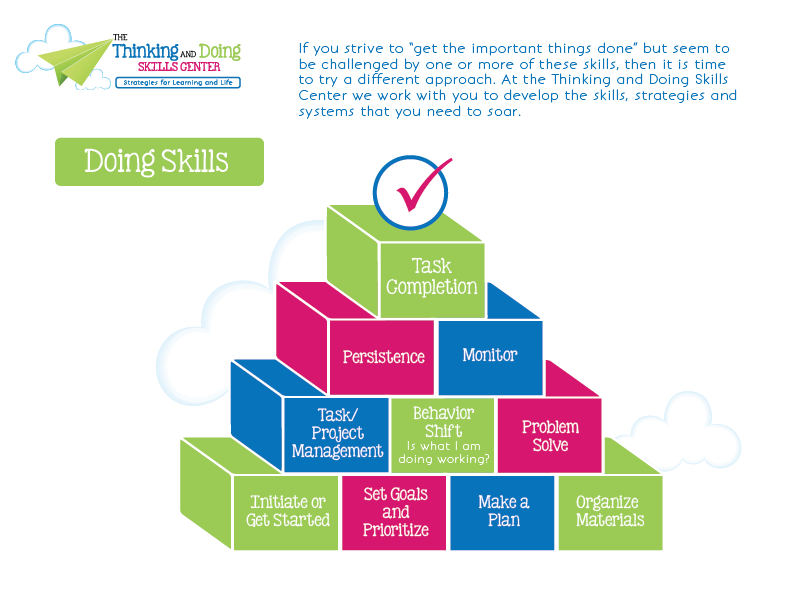
doingskills_NO-BARWith the start of the new school year, I thought it was important to revisit the art of getting started previously published on our blog in 2013.

The ability to get started on something is called “task initiation or activation” by the experts on Executive functions (Russell Barkley, Peg Dawson, Thomas Brown, etc). Executive functions are those skills that help us get things done.  Task initiation is just one of these executive skills and it involves the ability to START. Difficulties getting started can be the result of not knowing where to begin, what to do, how to generate ideas or how to problem solve to move forward on something. It differs from procrastination in that it is often not deliberate avoidance but a lack of understanding in knowing what to do to start. It can also show up as a difficulty with transitioning from one activity to another.

In children and teens, task initiation may show up as:

  • Difficulty getting started on homework
  • Struggles with generating ideas for writing
  • Problems with morning and evening routines (often needing excessive prompting to be ready for school)
  • Procrastination or being seen as unmotivated

In adults:

  • Procrastination followed by hyperfocus to meet deadlines
  • Projects that never get started
  • Unpaid or late bills, missed deadlines, and feelings of guilt

Removing the roadblocks:

  1. Is the environment getting in the way?

If your space is cluttered or you can’t find what you need to get going on something then it is time to take care of that. You end up expending more energy just looking for what you need to get started that by the time you do that, you don’t have the energy or inclination to continue. Declutter your work space, set up materials you use often in easily accessible places. Rulers, scissors, pens and pencils fit nicely in a mug on the desk. Set up colored plastic folders or boxes to hold all pieces of an ongoing project. Take everything out of the backpack and pile the “to do” items on the left and as you complete them move them to the right.

  1. Are you not sure what to do?
  • Get help understanding what is expected (call a friend or coworker).
  • Break it down into smaller pieces and pick one piece to start.
  • Work with a friend (use them as a body double to get you started).
  • Have someone tell you what to work on.
  • Use a graphic organizer.

Start with the end in mind. Sketch out what it will look like when completed and work backwards to determine the first few steps.

  1. Nudges, pokes and jabs:
  • Visual timers, alarms, and phone reminders all serve to designate a start time if you use them.
  • Set the sleep timer or automatic shut off on your TV, or use ifocusonwork.com to help shut down other distractions so you can get started on the important things.
  • Set false deadlines for yourself or have someone else set them for you.
  • Put your cellphone in another room and don’t check it until you have worked 30 minutes. Use a timer here so you are not constantly checking how much time has passed.
  • Make a deal with someone that you know has your best interests at heart and ask them to help you get started.
  1. Routines
  • Create a basic week plan so that you know what day you will do what.
  • Students set up a routine for your homework with a break, snack and start time. Then work for 30-45 minutes before taking another break.
  • Start with the easiest to build momentum.
  • Meet your friends at the library to do homework together.
  • Create a mnemonic that helps you get ready to begin and use it daily.
  • Create a play list for the length of time before you need to start and use it daily. The more you listen to it, the more your body and brain will get the message that it is time to get to work as soon as this is over.
  1. If you still can’t….
  • Just start, after about ten minutes you will get into it.
  • Create a mind map or draw out what you need to do. Use colors and shapes to help your brain remember them and pick one.
  • If you are really procrastinating on something, stop and consider, “What is the worst that could happen if I didn’t do this? If it’s not too serious, then let it go or delegate it.

Often times looming deadlines, promises to others and fear of failure will push adults to complete a task they have been putting off. Many students though are not motivated by deadlines, grades or loss of privileges. They need help in learning what is preventing them from getting started and help designing a strategy that will work for them. Our group classes can help them find the strategies that will work for the way they think. Next classes start Oct 7 and 8th.

What Is a Thinking Skill?

blooms-taxonomy-2-150x150To “think” is to use your mind actively to connect thoughts, ideas and facts together to generate new ones. Using Bloom’s redesigned taxonomy as a guide we can see that thinking begins with the ability to “remember” and develops through several stages to “creating.” These stages are called higher order thinking skills. They are the skills we use every day jto problem solve, and think critically. They are also the skills that students will be asked to demonstrate using the Common Core of knowledge on the PARCC test.

To be able to get to the highest level of create, we need certain skills:

  • A strong working memory (or a reliable way to help it)
  • Ability to interpret information
  • Make inferences
  • Compare and contrast
  • Ask questions
  • Look for new connections
  • Analyze information
  • Think “outside the box”
  • Become an active learner
  • Think about your thinking
  • Take chances and don’t be afraid of failure

We all have areas we are stronger in than others. Here are some of the executive function skills that can impact your ability to think and create. Can you see how difficulty with any of these skills can hinder your ability?

  • Getting started – are you getting the things that need to be done, done?
  • Focus – can you work long enough with enough attention to detail to finish accurately?
  • Inhibit – are you impulsive?
  • Monitor – do you see how your actions affect others?
  • Cognitive flexibility – do you get stuck in your thinking or continue to do things the same way expecting a different result?
  • Working memory – forget what you are doing or how to do it, temporarily?
  • Emotional control – can you control your emotions through frustration, anger, stress, and/or boredom?
  • Metacognition – are you able to think about your thinking?

How do these skills play out in the real world? For adults, it may be about making a good decision, solving a problem in a unique way, or putting information together in a new way that leads to something improved. It is about having a spark of an idea and being able to slowly ignite it into something wonderful. Thinking is what keeps us and the world moving forward. Teaching students how to “think” and solve problems is essential for humanities sake. After all, who knows who will solve the BIG problems the world faces?

Homework Coach or Enforcer?

frustrated over homeworkIs homework a battle in your home? If you find that it has become a nightly battle or that your child or teen has lost interest in school; then it may be time to try a different approach. I will admit I sympathize with teens trying to become independent when often the adults around them are inadvertently taking away their sense of control. If you find that you are constantly asking them if their homework is done or suggesting ways for them to get it done then here are five tips to take you from homework enforcer to homework coach. Remember the role of a good coach is to encourage problem solving skills, develop independence and provide support when needed.

          • The first and most important step is to realize whether or not you are enabling your child/teen to feel helpless. If you are constantly reminding them to do their homework, get ready for school, pack their backpack, or go to bed why would they need to remember? The same thing applies if you are solving their problems for them or designing their notebook your way. All of these things take the pressure off of your teen and puts it on you. You’ll need to work together to figure out how much your teen can do independently and what he or she might need a little support for. I know it is often easier to keep track of it yourself, but teaching your teen to problem solve, keep track of assignments and get their work done independently are all skills they need to develop for a successful life.
          • Ask questions that begin with the word, “what” rather than “did” or “is”. Questions that require a simple yes or no answer will only get you the one word answer. Ask a question that requires them to answer in a sentence that gives you some real information. For example, “What homework do you have left to do?” This sounds less judgmental and requires more than a one word answer to reply. Good coaches ask higher level questions that need explanations, rather than simple one word replies.
          • Start with the end in mind, is a term that Stephen Covey used but is helpful for those having trouble with completing homework. Help your child visualize what that assignment or project looks like when it is completed. Then you can guide them to work backwards to include all the steps necessary to get it to that point. You can also help “backwards plan” long term projects with specific dates to work on the pieces of the project. If necessary, create the plan together and then have certain check ins rather than always asking if it is done.
          • Discuss with your child/teen what kind of an environment is best for them to work in. Do they like it quiet and away from the rest of the family or do they like to be where the action is? Many younger students don’t like to be alone in their rooms, for them it is easier to work in the kitchen or close by. Use a trifold foam board to create a distraction free zone and keep the TV and radio off and let them use their own music with ear buds. I have read that music can “satisfy” the hungry ADHD brain by providing enough stimulation to help it relax. This is done by listening to the same playlist every day during homework time. It is not picking each song but pressing play once and letting the same music play lightly in the background for about 30-45 minutes. That is long enough to get some work done. Have them take a short break and then get back to their homework and play that list of songs again.
          • Make sure your children have some “down” time. Everyone is entitled to relax after a long day. In fact, research says that having some down time after working, helps the brain to process what was just learned. Many students are not getting the 8-9 hours of sleep they need to do their best. Those with ADHD will benefit from designing a “routine” for sleep. Start with shutting down electronics at least 30 minutes before bed (the blue light stimulates serotonin the wake up hormone), dim the lights (good for increasing melatonin the sleep hormone) and relax. Add in the other bedtime get ready tasks and aim to have them in bed around the same time each night. Aim for at least 8 hours but 9 is ideal.

Parents, you are your child/teen’s life line.They may continue to need your support throughout school but as they enter middle and high school, it is time for them to develop their problem solving skills. That means they don’t need you to solve their problems or challenges for them but to work with them to come up with solutions together. Stay calm. When stressed, cortisol, the stress hormone, is released into the body and it can literally shut down the brain making it nearly impossible to think. Students cannot force their stressed brain to think at that point and it is best to take a break and go do something active. Exercise increases the level of dopamine and other neurotransmitters (good chemicals) in the brain that can help get them back on track. If the situation gets too stressful, it is best to just walk away. Homework is homework….let the teacher deal with it.

Thanks for reading,

Laine

7 Steps to a Successful Day

Late againEver have one of those days when everything seems to go wrong? Well research now says that a chemical change occurs in the brain when the first thing goes wrong in the morning. Then our reaction to that one thing can set the tone for the rest of the day – even after the chemical change is over. Bad days happen to all of us now and then but here are seven steps that can turn those days around. Start tonight!

1. Set a bedtime! This is first because it can make the difference between having enough energy to get through a busy day or feeling sleep deprived and self-medicating with caffeine or food all day long. Make sure you get enough sleep (7-9 hours for adults) to wake up refreshed.

2. Make a plan the night before. What are your priorities, list appointments and/or meetings and think about what you need to get done and also what is coming up in the next two days?

3. Decide what you’ll eat tomorrow. What is for breakfast, lunch, dinner and snacks? By thinking about it ahead of time you are less likely to make unhealthy choices. Having a weekly meal plan takes the stress out of thinking about what to prepare for dinner each night.

4. Load the launch pad. That area near the door where you keep all that you need to take with you will take the stress out of your morning rush. Make sure keys, pocketbook, cellphone, id and anything else you need is ready to grab at the door. Put out tomorrow’s clothes and jewelry as well. No thinking in the morning required.

5. Plan when to “move it” for 30 minutes tomorrow. If you try and wait to see what “feels like” a good time to workout, you probably won’t. By setting the time ahead of time, you can set out your clothes, call a friend to meet you for that walk, or just wake up ready to exercise and know that you have started your day off on a positive note.

6. Drink more water. According to the CDC we don’t drink enough water. So bring a few bottles with you so that you have them ready and space them out throughout your day. Getting the bottles ready the night before, makes it just a matter of grab and go. (Or get yourself a large refillable, non-plastic bottle.)

7. Allow extra time in the morning. If you don’t like to jump out of bed as soon as the alarm goes off then allow for extra time. You want to be able to get ready for the morning at a leisurely pace and not have to be rushing here and there. Stress can affect your entire day.

Do whatever you can the night before to make your morning run smoothly and you’ll feel so much better at the end of your successful day.

Lights! Camera!…..ACTION! 15 Steps to Get Going

frustrated studentTaking action and following through on something that has to be done is often difficult for those with ADHD or Executive Functioning challenges. In most cases, students and adults understand the importance of completing something but find it difficult to actually “move themselves” to action. What is happening in the brain, in my understanding, is that the level of dopamine is not sufficient to reliably carry messages/signals from one side of the brain to the other or to provide enough motivation for action. That makes this difficulty neurobiological and not motivational. There is a big difference there as often we have seen things get completed before and feel that if it can be done once why not every time? Such is life with ADHD and/or Executive Dysfunction. Inconsistent ability to take action doesn’t occur alone, it often involves other executive functions like, organization, planning, working memory, task initiation, self-regulation, focus and time management. So rather than it being one simple cause, it is often a combination of things that is getting in the way. Also not learning from previous experiences plays into why this same thing continues to happen over and over again. If possible try to break it down to see what is really getting in the way and work on one piece of the puzzle at a time.

Here’s what it may look like in students:

Inconsistent ability to complete homework regularly (or long hours spent doing it)
Last minute approach to long term projects
Being late or last minute
May look like a lack of motivation, not caring, or teen age “attitude”
Failing tests due to inability to study enough (or up past midnight studying)

In adults:

Often late (but only by a little bit) or last minute on meeting important deadlines
Procrastination and/or lack of follow through
High energy and always appear to be very busy without actually accomplishing a lot.
“Paralyzed” when they don’t know how to do something or don’t want to do it
Inability to prioritize

Here’s what can help:

    1. Make a “must do” list that only includes the top two or three things you must get to
    2. Start with the most interesting task first
    3. Set false deadlines for yourself or be accountable to someone else for completion
    4. Break it down into manageable size actionable steps and use verbs for each step
    5. Set goals and behavior contracts weekly with students (too far in advance is worthless)
    6. Act as a body double for your student by being close by during homework time and doing your “homework”
    7. Teach your child to “talk to themselves” and ask questions to keep themselves on track
    8. Support them or provide supports for them but don’t do it for them
    9. Keep the end in mind – what will the homework look like when completed and what will I do after it is?
    10. “Suffer” through five minutes – it may motivate enough to keep going
    11. Exercise or do something active to increase the dopamine in the brain before beginning (snacks and water help too)
    12. Remind yourself and/or your student of past successes
    13. Change the environment, change the task or change the expectations
    14. Use timers and allow five minute breaks for every 30 minutes of work (minimize distractions)
    15. Use plenty of positive reinforcement that mentions specific actions you see your child doing

Motivating someone else or even yourself to take action often depends on how important the task seems (that adrenaline rush is actually raising the dopamine levels too). If someone else (usually your kids or spouse) is waiting on you to do something you may be more likely to do it. In school, students can often “force” themselves to get something done for a favorite teacher or subject but may feel it is torturous for their least favorite. Start small and put checklists, timers, notes to self (especially where you leave off on a project) and use the steps above that help. Having something to look forward to can often provide an extra push so be sure to reward yourself and/or your child. Now, get going!

What to Do When You’re Stuck in the Mud with a Fried Brain

fried brainThe pressure of homework or rather the pressure of finishing homework for that valuable checkmark is taking away from the point of homework. It used to be that homework was a review of what was learned in school that day, but now often times students are “re”teaching themselves because teachers do not allow enough time for students to process new information.

When students get really focused or feel pressured to get their homework done it is almost like they put blinders on. They are no longer really learning the material they are just trying to get through the assignment. I want to give them credit for persevering but also want them to know that at some point they become less effective and should stop. How many times have you seen your child do a math problem over and over again expecting a different answer? Middle and High School students often have the answer to the math problem and their job is to set up the equation and get that answer. Lots of things can go wrong in this process (calculation error, wrong sign, solved in the wrong order, wrong equation, etc.) but students tend to erase and start again – exactly the same way.

This is called cognitive inflexibility. It happens in kids, teens and adults and is the inability to switch your approach or your thinking to problem solving when what you are doing isn’t working or something changes. It is like getting stuck in mud and not even realizing it. So in the above example, they erase the problem and because they are not 100% tuned in, they could be repeating the same process or same error over again. This can go on and on and that makes homework take longer and longer. Talk to your student about this at a time when they are not stressed about homework and print out the four steps below for them. Help them add to the list.

What to do when you are stuck on your homework:

1. Stop and take a look at what you have done. Check for errors or misunderstandings. If you don’t see anything then go to number 2.

2. Take a non-electronic break (5-15 minutes) and let your subconscious mind work on it and then go back and try it one more time.

3. Stop erasing and use a whiteboard after the first attempt so you can see all of your answers. What is happening?

4. Brainstorm other things you can do. For example you could: Skip it and come back to it, call or text a friend in your class, go back to the text book and reread key information, check your class notes, go in early or stay late for extra help, Google it or use a website like www.khanacademy.org to help.

For whatever reason, students seem to think that they “shouldn’t” use other resources to help them solve a problem. When this happens, they often end up wasting so much time trying to figure things out when a simple search or call to a friend could solve that quickly.

Exercise and Your Child’s Brain

exercise brainMarch usually marks the middle of the third term of the school year. For some children the winter months are the most challenging. With shorter days and cold, sometimes snowy weather, they are less able to get outside and burn off their extra energy. This makes it difficult for them to “settle down” and get working on their homework.

There is actually a neurobiological reason for this and it has to do with the neurotransmitter chemicals in the brain. I won’t get technical here, but there are three main chemicals in the brain that influence learning. They are serotonin, dopamine and norepinephrine. These chemicals work together to focus, motivate and improve learning in the brain. In his book, Spark, John Ratey, says that exercise improves learning in three ways. I’m paraphrasing but it helps to improve alertness, attention and motivation, helps the cells hold onto new learning and spurs the development of new brain cells. All of which are necessary for new learning and of course for homework.

Here’s how you can help. If you notice that your child is struggling to settle down to do their homework don’t force them. That tends to shut down the brain making it harder to work. Instead, encourage some activity for 15 to 30 minutes. Set a clear time frame so that your child is not surprised that they have to get back to their homework. Provide a five minute and a two minute audio and visual reminder to help with their transition back to homework.

Most middle school students can focus for 30-40 minutes and for elementary age children it is about 15-20 minutes. It’s important to break up your child’s homework time with 5-10 minute activity breaks after a period of focused work. Also providing a snack of lean protein can increase your child’s level of dopamine. Dopamine helps the brain carry the messages from one side to the other. (For children with ADHD, medication helps to increase the level of dopamine allowing the brain to feel “comfortable” and to process the information more efficiently.)

So get your kids active and watch their ability to focus increase and the amount of time they spend on their homework may decrease.