Decision Fatigue is Real – Let’s Make it Easier

Decision fatigueTired of struggling to make the “right” choice?

If you’ve ever stared into the refrigerator hoping that a dinner idea will magically appear, or struggled to decide which task to tackle first off of your to-do list-you are not alone. It’s not because you don’t know what to do, and it’s not laziness, it’s your brain “waving a little white flag, especially if you’re juggling ADHD, high expectations, or have a habit of putting everyone else’s needs first. The more decisions you have to make in a day—big or small—the more drained you feel.” 1  That’s decision fatigue.

Decision Fatigue

Every day we wake up with a certain amount of mental energy and each decision or choice we make uses up some of that energy. So, as the day goes on and our decisions start to add up, our mental energy decreases. That’s when decisions become harder to make and so you might put off making them, or feel stuck, or make a hasty decision you’ll regret later.

Give Your Brain Space to Breathe

The first step is to reduce the number of choices you need to make each day. That will free up some of that decision making energy for you to use on the more important things and give your brain space to breathe. Think about how many decisions you are making just to get up and out in the morning. (Ex. What time to get up, what to do first, what to wear, what to eat, etc.)

How to reduce the number of decisions? Simplify the choices you have to make early in the day and create routines that become automatic habits that no longer require mental energy.

Where to Start?

Start with the easy things that don’t take much brain power at all that you can do the night before. Things like deciding what you will wear, what you will eat for breakfast, what you need to bring with you, etc. If you set out what you can, then that part of your morning will go smoother.

The next phase would be to simplify what you can by planning ahead. Where do you feel the frustration building? For me, it was often around dinner. I was all out of decision making power by the time I was supposed to start working on dinner. I would stare into the fridge or pantry and hope something would jump out – it rarely did. Now, I use a blank calendar on the pantry door to write in the meals for the next week. Usually, it goes from Thursday to Wednesday so that I can get what I need on Thursday at the grocery store. When I am creating the menu, I put anything that I might need on the Alexa shopping list. It’s not perfect but it does have an added advantage….if I am not home or am on a call, anyone else can check the menu and get started on dinner.

Other ideas you might want to try is to designate certain days of the week for certain activities like admin, meetings, grocery shopping, errands, laundry, etc. That way you know when something will be taken care of and don’t have to try and fit it in when it becomes urgent on a very busy day.

Creating routines can also help to take the strain off of your brain. Yes, it can be boring to do exactly the same things in the same order every day – but you are saving your decision-making power for more important decisions later in the day. A morning routine and an evening routine would cover the basics but you can also create an end of the work day routine, a weekly reset routine, or even a bedtime routine with the kids and be instilling great life skill habits in the process. Once these routines become autopilot, your brain can relax and save it’s energy for more important things.

Take a look at the times of the day or the things that seem to cause more stress in your day and figure out if a routine would help, or if you can simplify it or do it the night before or even delegate it. The choice is yours. If you feel like you’re just “burnt” at the end of the day, then it’s time to also look at your self-care habits to make sure you are getting enough sleep, exercise and healthy meals. After all, you are worth it.

Take 5 minutes today to set up one “go-to” or default option – a quick breakfast option or an outfit you feel great in, whatever it is, set it up and try it out. Let us know on our facebook page, the impact it has.

*1 Chatgpt definition

From Busy to Effective: The Art of Balanced Productivity

Personal producitivtyPersonal productivity, is the art of getting things done or as ChatGPT defines it, “Completing tasks, managing time, and achieving goals in your daily life or work.”
Are you happy or should I say satisfied with your level of personal productivity?

Let’s take a closer look at that definition. The first thing it mentions is completing tasks. What tasks does it mean? If it is the tasks on my to-do list then there isn’t enough time in the day to do all of them. How do I choose? We’ve all had an extremely busy day of getting things done but at the end of it, we either can’t cross anything off the list or we feel like we really didn’t accomplish anything important.

Every day, everywhere we look we are exposed to all kinds of options and choices. Sure, we’d like to do it all, but it is probably not humanly possible. So, we have to make choices. Choices should represent the important things, those high impact tasks that make a big difference but are not a lot of work. Knowing ahead of time what those tasks are takes some thought (usually ahead of time) to be most effective.

One way is to create a realistic plan for the week based on the available time you REALLY have and then ask yourself, “What is really important for this week?” If you have a master list of your tasks, then just going through that will trigger the important things but remember….you can’t (and shouldn’t) try to do it all.

Take the tasks that you feel need to be done this week and write them down on a new list. Now, based on the available time you have, the time of day, and the priority level of the task, decide where in the week will you get that done? Having a plan allows you to see not only what the most important task is but also, how other tasks may be grouped together to save you time and energy. Estimate how long your tasks may take to be sure you are not trying to be a super hero.  Or you can wake up slowly on Monday morning and wonder, “What do I feel like doing today?” I know I would go for the easiest tasks but those are not usually the most important ones, are they?

Managing Time

Managing time is mentioned next in the ChatGPT definition above, but what does that mean? I certainly don’t know how to “manage” time, in fact it often flies by without me even noticing it, how can I manage it? Did you notice after the clocks changed, how much faster the day went by? It wasn’t really faster, it just seemed like the day was longer, because the sun was out longer. Time ticks away a minute at a time no matter what we try to do about it. We can only “manage” ourselves by following our plan, limiting what distracts us (unless it’s our kids) and having clear boundaries around our time.

You can “save” time by having habits and routines that keep the family current.

Which would you rather….

  • Do 2 loads of laundry or 7?
  • Take 30 seconds to put dishes in the dishwasher or wait until the sink and counters are full?
  • Know what is for dinner and have it or figure it out at 7:30pm?
  • Have kids put their toys away before bed or risk stepping on a Lego in the dark?
  • Start the week with a full tank of gas or risk being late for that meeting because you had to stop for gas?
  • Paying your bills on time or risk having to pay the late fee?

By having set days or times that you do certain tasks automatically, you can save energy and time and lower your stress. When the children are involved in the daily chores, they develop accountability and responsibility. Working together can build their confidence and self-esteem. Pitching in can develop cooperation and teamwork while they learn essential life skills like organization and time management. It’s a win-win situation.

Achieving Goals in Your Daily Life or Work

The third and final piece of the personal productivity definition is, “achieving goals in your daily life or work.” A goal can give you a glimpse into the future and maybe provide motivation when things become difficult. It is your “why.” It points you in the direction of your best self but it doesn’t tell you how to get there.  That’s where “PACT” can help. PACT is an acronym, similar to SMART that is used to create goals, but PACT is more focused on the actions needed to attain a goal. PACT stands for Purposeful, Actionable, Continuous, and Trackable.

PACT pushes you to go deeper and to think about the actions needed to get to your goal. It focuses on output – actions you can do now to move you in the direction of that goal. If that doesn’t work, the “C” encourages you to try something else. Continuously working towards your goal by designing different experiments, like a scientist might, to collect the data on your results. You can easily see that because you are keeping track and adjusting when necessary.

So, if you are looking to improve your personal productivity, first, think about why. Why do you want to be more productive? Is it just to get more done? I hope not. Is it to follow through on what you have already agreed to and is it essential enough for you to give your irreplaceable, and limited time to? If not, then let it go. There is a big difference between what we need to get done and what we “want” to get done. Check your list, cross off anything you can. Focus on the important things – those things that move you in the direction you want to go in. It’s not about how much you get done. It’s about getting the important things done and to do that…..

Make sure to:

  • Take care of yourself
  • Create habits and routines that make life easier
  • Plan ahead
  • Reset nightly for the next day
  • Get the family involved
  • Focus on the important things
  • Take time to recharge

If you’re feeling overwhelmed or confused on where to start, then use the above list to help you figure out a PACT goal that will lead you to the actions you need to get there. For example:

P – To have enough energy to feel good and get through my day

A – Go to bed at 10pm every night

C – Might need to go screen free at 9pm

Or make sure the kids go to bed on time

Or shower in the morning

T – Track what time I do go to bed (and how do I feel the next day) That is one simple example of how you get to “taking care of yourself.”

Now it’s your turn, what is one thing you can do to increase your level of productivity? Let us know on our FB page.


Image by TyliJura from Pixabay

Slow and Steady Makes A Productive Day

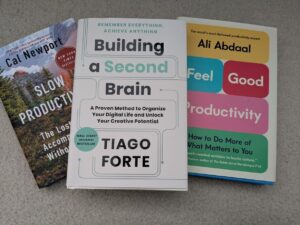
Productivity BooksEvery day in multiple ways we are bombarded with information. Whether it is auditory, visual or both, information is all around us even if we don’t want it to be. According to an article in the NY Times, in 2009, as quoted in Building a Second Brain, by Tiago Forte, “the average person’s daily consumption of information now adds up to…34 gigabytes” or about 174 newspapers worth per day. A quick Google search shows it is now up to 74 gigabytes or 16 movies worth a day! Who could sit for that long?

There’s a problem with too much information whether we are consuming it ourselves or are just being exposed to it. We can’t hold onto the information long enough to use it or remember why we read it in the first place. Even if you could remember it, could you find it? What is the point of this new knowledge we’re learning if we can’t use it to improve our lives in some way? Students must wonder about that all the time.

What is Productivity?

If you’ve ever felt overwhelmed or like your brain was about to explode, then you know it is a stressful feeling and it interferes with your ability to get things done.

We all want to be more productive; it is one of the most common New Year’s Resolutions. Well, chatgpt defines productivity as, “how efficiently and effectively you use your time, energy, and resources to accomplish tasks, achieve goals, and improve your overall quality of life.”

To improve your overall quality of life is the key point, because what is the point of doing more if you just feel unhappy, stressed, overwhelmed, or brain dead?

How to Start

In order to make good decisions about the tasks and projects that are important to you, you need to know what they are. When was the last time you wrote down EVERYTHING that was on your mind? (I call it a brain dump but some prefer the term a cranial cleanse.)

Remember a project is anything that has two or more tasks/steps before it is complete. Maybe just think about the projects you would like to complete in January. No, you can’t do all 100 of them, but you might be able to finish 2 or 3 of them and remain sane at the same time. How would that feel?

Steps to Slow Down and Do More

    1. Work on fewer projects. Cal Newport, author of Slow Productivity, suggests not taking on a new project until one of your initial projects is completed. We often try to cram more work into an already overloaded schedule, without thinking where that time will come from. So, making space first makes sense. (Hide the rest of the list until you are ready.)
    2. Before you decide on which projects you will take on, think about what would make you feel fulfilled and pleased to have accomplished by the end of this month?
      • Is there something you have been meaning to do concerning your health?
      • How about a Home project that is haunting you
      • But most importantly, is there something you want or need to do that would make you feel productive and possibly even recharge you?
      • Make some time daily or at least weekly that you can do whatever it is that recharges your batteries. Even just a trickle charge can keep those batteries running during the coldest (bleakest) of times.
    1. Now based on the projects or areas of your life that you have listed to work on, set up a digital folder or notebook page to collect incoming information that will be helpful for it. Keep track of the info you consume in a way that allows you to use it later. This comes from Building a Second Brain. The concept is simple, take notes and keep them in a digital app that you can search and use easily.

Is being more productive about managing your time better? What is time management really? We can’t manage it or slow it down or save it to use later. It is really about energy management. Your energy is what determines how well you get things done. By collecting the information that is important to your tasks and projects, and putting it all in one place, you are saving yourself time, effort and brain bandwidth. Cut down on the information you really don’t need as it just takes up space in your memory and often isn’t a priority of yours anyways.

Do remember to take good care of yourself including; sleep, nutrition, movement, and screen free down time so, you can feel your best. Everything is more difficult if we aren’t feeling our best, don’t you think?

Seek out the resources and the tools to help you manage your tasks and limit what you are focusing on so it is more manageable. That should help you save time and mental energy. Good luck.

3 Steps to Solving Your Organizational Challenge

Happy 7th Anniversary to me! Seven years in business that is. Today starts my eighth year but today is also important for another reason. It is the same day many, many years ago that I decided to get organized. I remember feeling overwhelmed and frustrated and started looking for information. I started devouring anything I could find on getting organized. Back then there was not a lot of information out there. Today, if you Google “get organized” you’ll get 32,800,000 hits in .34 seconds. That’s a lot of information!

The “get organized” business is a lot like the “diet” industry – everyone has their own ideas and they may or may not work for everyone. So how do you decide what to do?

Here are the first three things you should do:

1. Find the root cause. What is it that is really bothering you or causing a problem? Keep asking yourself questions until you can get to the root of the problem. For example, paying a bill late – why does that happen? Is it because the bills are mixed in with the pile of mail and aren’t seen? Or is it that it gets moved from table to counter? It could be, but it’s more than that. Is it because there is no plan of when to pay them? Probably.  The system to handle the bills is missing and needs a few things. So, once the problem is narrowed down you can proceed to step 2.

2. Analyze your options. Figure out all the possible things that might solve the challenges that you discovered in finding the root cause above. Then write down anything and everything you think might have a positive impact in resolving the problem. Then go back and pick two or three things you can do to solve the challenge. To continue with our example, let’s find a home for the mail by using a basket or bin or mail sorter bin, but keep the bills separated by putting them in their own basket. Then decide on what a “bill paying” plan or process might look like. (Do you need a chart to list the bills, or to put a reminder on the to do list? You get the idea.) Analyze your options and decide what changes would have the biggest impact.

3. Try it out. It takes three weeks (sometimes longer) to create a new habit but you should know in a few days whether or not your new solutions are working. You may have to “tweak” it to improve it, but don’t quit if it doesn’t work perfectly the first few weeks. Keep asking, “What can I do to make this work better?” Then try that. Keep trying until you solve it – here’s where you can “Google” to get specific ideas related to what you are trying to change. Using our example, maybe we see that adding “pay bills” to the to do list isn’t helping. Continuing to look for solutions, maybe you try deciding to pay bills every Friday and put that in your planner.  Or maybe you set up all your bills to be paid online through your bank. Whatever you decide, go back to question one and see that it has solved the original problem. If so, then move on to the next challenge.

Just remember to keep it simple. Good luck!