Does Homework HAVE TO be a Battle?

Homework frustrationThe simple answer is NO! Homework does NOT have to be a battle.

The purpose of homework is to help reinforce the learning from class. It is also to encourage responsibility, independence, the development of time management skills (which are really self-regulation skills) and practicing problem solving strategies. Sounds great, is that what is happening in your home?

Or are there tears, tantrums, yelling, defiance and meltdowns? Or maybe it’s bribes, rewards or threats of losing what they hold most dear. What’s a parent to do if the kids are just not motivated to get started on their homework?

Where’s the Motivation?

Motivation is a challenge. An ADHD brain struggles with tasks that are boring, complex or difficult. If you are trying to motivate your child to complete something that falls under one of those categories, (like some homework) it may be as frustrating for you as it is for them.

“Motivation is a set of habits and routines, guided by your values and your identity, that you carry out every day.” “When you combine purpose, energy and small simple steps, you get sustainable motivation.” says Jim Kwik, author of Limitless.  Are you ready to change this?

How to Make Homework Less of a Battle

Create some structure – the school day is very structured. Students know what is happening each day and at what times. There are routines in the classroom that are followed and the expectations are clear.

James Clear (of Atomic Habits fame) says, the smaller the step, the more likely you will be motivated to do it. He also suggests that you schedule when you will work on it because you are more likely to work on something that has been scheduled rather than waiting until you feel motivated to work on it. Waiting for that feeling – rarely happens but you can help encourage motivation by setting up a routine that tells the brain it is time to get working on “x”. Clear calls it a “pregame routine” where it starts a series of motions that are simple to do but moves you in the direction of actually working on whatever it is. We’ll call it the “pre-homework routine.”

Pre-Homework Routine

At home, there should be clear expectations, structure and routines as well. Starting with what happens when they come home from school. Decide together what is the littlest thing they can do? For some that might be closing the door – others it might be taking the lunch box out of the backpack and putting it in the kitchen. Baby steps to start and then:

  • A protein snack will help recharge their tired brain
  • Taking 30-45 minutes of downtime (especially outdoors) will help to reenergize them.
  • Screens are a distraction and a time suck, so should be avoided until after the homework is done.

Homework is your child or teen’s “job” – they are accountable to their teacher, but more importantly to themselves. If they don’t do the work, they will get the zero. If they are not motivated by grades, just keep showing them the grade portal and the impact of each zero. No one really wants to fail. Sometimes, all the fuss is not about starting the homework at all. Sometimes, they are feeling overwhelmed or frustrated or even confused. They might be looking for your attention or trying to manipulate you into letting them disrupt the routine. Try to understand what is really bothering them. Offer some options, show empathy and encourage them but don’t let them manipulate you into postponing the homework routine.

  • Set a “homework time” to begin each day after their initial break. They can take short 5-minute breaks after each 25 minutes of work time (depending on age).
  • Designate a desk, table or counter as the homework zone and make sure it is clear and relatively distraction free. Check the chair and the lighting and put an analog clock within view.
  • If they choose not to work during that time, make it clear there will be no homework being done after a specific time. They need to have time to “chill out” between homework and bedtime.

The role of the parent, just like the teacher, is to set clear expectations around the homework routine and process. You are helping them create habits that will serve them their whole life.

  • Encourage independence but be available to guide them to their own solutions when stuck. Don’t provide answers.
  • Keep it positive. Praise their effort and persistence rather than their intelligence or skill. According to ADDitude Magazine, “When you praise your child, it creates dopamine — the neurotransmitter his or her brain lacks, which causes the ADHD symptoms— and the dopamine helps them to better control behavior. So, he or she can do more wonderful tomorrow.” It also helps to increase the positive/negative ratio. Do you know that it takes 3-5 positives to offset 1 negative comment?
  • Check on them occasionally but don’t interrupt them unless they are clearly distracted. Each interruption adds more time to regain their focus.
  • Be consistent as much as possible. Use a calendar that everyone can see and let the kids know what is coming up.
  • Each week, help them “reorganize” themselves by cleaning out their backpack, checking the agenda for what is coming up and depending on their age, making sure they have clothes for the week or have them do their laundry.

It will take longer than you think for the homework routine to become mostly automatic. Use a timer or something that lets everyone know it is time for it to start and stick with it. Creating routines reduces the stress of not knowing what to do next, helps a struggling working memory and best of all takes the battle out of the homework.

Learning happens when students are willing to learn, and have strategies that work for them like a homework routine. However, most important is that they feel good about themselves. So, use lots of praise (about their effort), humor and help them understand how they learn best. If school is a positive experience, then their superpower may one day make the world a better place.

Action Today = Better Learning Tomorrow

Reading books, lots of themCalling all parents….do you want to help your child/teen complete their homework more efficiently, study more effectively for tests and ultimately improve their learning and their grades?

Time is running out. We’re in term 3. The early Spring is often the most difficult time for students to stay motivated and to keep up with their work. Keep it positive and read on for tips to put into action today for better results tomorrow.

Homework Efficiency:

        • Work together to set a homework routine. Include a specific start time.
        • Create a distraction free environment – TV off even if it is in another room. Phones on airplane mode or out of the room.
        • Do not interrupt them while they are working as they can lose their focus.
        • Do not “check” their homework accuracy, that is the teacher’s job.
        • Make sure they take short, 5-10 minute, breaks after working for 20-30 minutes. It helps the brain recharge and allows the brain to process new information.

Study Effectively:

    • Encourage students to write down upcoming test dates and then to plan backwards so that they have at least 3 opportunities to review the information before the test. Spaced repetition has been shown to be an effective study technique.
    • Foster a growth mindset, discourage negative self-talk and focus on the positives. Punishments do not encourage better grades.
    • Simply reading new information retains maybe 10% but being an active learner by asking questions, summarizing the reading, drawing a mindmap, or creating flashcards leads to more retention and better understanding of concepts.
    • Have your child “teach” you or even the dog, key concepts. They need to be able to explain them in their own words and just not verbatim from the text or study guide. Quiz them on vocabulary, including math vocabulary to be sure they understand what the words means.
    • Don’t save studying until after the homework, as it is best when the brain is fresh and energized

Improve Learning:

    • Eat together whenever you can and engage in meaningful conversations about various topics. Discussions promote communication skills, critical thinking and listening skills and develops confidence.
    • Read. Whether it is reading to your child, with your child or they are reading independently, show that reading is important by reading at the same time.
    • Make learning fun by going to museums, libraries, zoos and vacationing activities that promote learning new things.
    • Encourage their interests and provide opportunities to explore hobbies, deep dive into subjects of interest and use their skills in the “real world.” (Ex. Baking, cooking dinner, planning a vacation, or researching a topic.)
    • Praise your child’s efforts and encourage them to see challenges as opportunities to learn and not as failures. Take the emphasis off of the grades and focus it on encouraging them to become lifelong learners capable of learning anything they set their mind to.

That’s how we encourage learning and growing and can develop the habits and routines that all students need to be successful. It only takes one “bad” experience in a subject to demotivate and defeat an otherwise very capable student.

Graphic thanks to Pixabay.

Top Three Challenges (and Solutions) for Back to School

The kids are back in school. YAY! Take a moment to celebrate the start of the new school year with all its possibilities. September is often a great month for establishing new habits and routines. If you feel that the mornings are rushed or you are frustrated when it comes to homework time, then read on for some solutions to help.

Three common challenges once school begins:
Challenge 1: How do I make morning routines work so I am not guiding or coercing my children and teens every step of the way?
        • Start with a set bedtime and figure out how much time it takes your children/teens to get into bed (this helps them wake up rested)
        • Have a prep time before bed when kids put their clothes out for the next day, pack up the backpack and place it near the door and decide what they want for breakfast, lunch and/or snacks. Find the water bottle and rinse out. Charge devices in a central spot and not in the bedrooms
        • Put alarm clocks in their rooms and show them how to set the alarm for a reasonable time to wake up (we don’t want the slow movers to have to hustle – but you also don’t want too much extra time for them to get distracted)
        • Set a timer as a warning for the bus (Alexa works great for this)
        • Depending on age, create a list, picture or have a mirror for them to check that they have everything they need to be ready before they head out the door. No slippers allowed
Challenge 2: How do I get my kids to get started on their homework?
      • Everyone needs a break after school. It is a great time for a snack break and a little physical activity. Both of those things will help stir up the dopamine needed to reactivate the brain for homework. Usually, 30-45 minutes is plenty.
      • Take the time to find out how their day went while things are still fresh in their mind. Don’t try to solve their problems but show them that you are truly listening and hearing them by using reflective listening.
      • Set a specific start time for homework and have a reminder timer set so they can hear it
      • At the beginning stay close by (and pretend you are working on something) just to see if they can get themselves started or if they might need help
      • If a timer is motivating you can ask your child how long to set it for and then allow them a short 5-7 minute break when it goes off. (Set the timer for the break too)
Challenge 3: How do I get my kids to finish their homework in a reasonable amount of time?
      • Most homework subjects can be completed in 30 minutes or less so setting a timer for about the same amount of time makes it easier to take a break after one subject is completed
      • Reduce the distractions – Move the cellphone away from the work zone just enough that your teen will need to get up to check it. After a while, they will turn the notifications off and/or stop getting up to check it. That also means no TV on in the background or younger siblings making loud noises nearby. It is hard enough to concentrate on homework without wondering what they are missing out on too.
      • Don’t book an afterschool activity every day of the week. Kids need a day that they can recharge and have some fun before they hit the books.
      • If your child struggles to stay focused, think about creating a buddy study time with a friend. It works like a “body double” where they have a better chance to stay working as long as their friend is working too.
      • Timing is key. Homework done after dinner takes longer to do as the blood that should be in the brain, is busy digesting dinner in the stomach. Homework done 2+ hours after school, has interrupted that “student” mindset and can take longer to get back into the “work mode.” Ideally, within 45-60 minutes after arriving home is the best time to get focused on homework.
      • For elementary and middle school students, homework should be able to be completed by dinner. That gives the rest of the evening for R & R. When teens feel they have the entire evening, until bedtime to complete their work, they often find it takes them that long or longer. Then they wonder why it is difficult to fall asleep when their brain is still processing the last 30 minutes of work they did. Setting boundaries/limits around homework time and keeping to the same start time each day will help your children get more done in less time.

If routines, habits and homework are constant battles in your home, and you would like to increase cooperation, communication and lower the stress level in your home – then let us help. Contact us today about coaching.

What to Do When They Won’t Change Their Mind

I once had a student that was having difficulty turning in his homework. He would do it, but when it came time to pass it in, he could not find it. He had a “homework folder” where all of his finished work was supposed to go, but his work was not there. When asked, “Where else did you look?” He was unable to answer. In his mind (we later discovered), if it wasn’t in the homework folder there was nowhere else to look. Does this sound familiar?

This is an example of cognitive inflexibility – difficulty changing or shifting your mindset when the most logical answer does not bring results. Needless to say, upon further searching, other homework papers were found at the bottom of the backpack, stuffed inside a text book and also on his desk at home. All papers exactly where he had left them, yet he had no recollection.

Cognitive inflexibility is real. It is one of the Executive Function skills that develop in the pre-cortex of the brain. It can be measured on certain IQ tests and on the Behavior Rating Inventory of Executive Functions. It has two components: a cognitive shift and a behavioral shift. Simply put, if your child cannot change their thoughts or their behavior when they realize something is not working, then it may be from cognitive inflexibility.  You may have seen it when they get “stuck” on their math, or they don’t know what to do, but won’t accept your help because you, “don’t do it like the teacher.” Or have you ever noticed their perspective of what happened, does not quite agree with the other person’s perspective? All related to cognitive inflexibility.

As an Executive Function skill, cognitive flexibility will continue to develop but, in the meantime, it can cause some issues. Try to help your child see other people’s perspectives. You can explain how things are not always “black and white” (another sign of this underdeveloped skill and often related to ADHD), and that there are always other possibilities. They can help themselves by starting with some simple questions.  A research study indicated that there was a close relationship between cognitive flexibility and inner speech among both children and adults.  It appears as though inner speech may increase top-down control during shifting of thoughts (i.e. flexibility). https://mentalhealthdaily.com/2015/07/26/7-ways-to-increase-your-cognitive-flexibility/

Try having your child ask themselves these questions:

Before starting:

“What do I already know that will help me?

“What should this look like when it is done?”

“What should I do first, second and third?”

During: “How am I doing?”

“Am I on the right track?”

“Is there another or better way?”

“What do I do if I get stuck?”

After: “What strategies did I use?”

“Did I get stuck or have to change my thinking?”

“What did I learn from this?”

Developing this ability to shift thinking or shift behavior can also be improved through games and activities. Games to encourage the development of cognitive flexibility include: Set, Othello, Connect 4, Mastermind, and Gobblet. Activities include: Stroop (where color words are written in different colors and they must say the color they are printed in), optical illusions, maps with multiple ways to the destination and Tower of Hanoi. Other activities include changing up routines, learning a new skill, exercise, getting out in nature, and video games that have multiple streams of information that have to be manipulated simultaneously.

For more strategies: Check out our blog, Stuck? 12 Ways to Encourage Cognitive Flexibility


Attention 101

Good habitsOctober is ADHD Awareness Month, so let’s talk about attention. Does your child take a long time to complete their homework? Have you heard things from the teacher like, “your child needs to pay more attention in class,” or “he/she is distracted and needs to focus more?”  Well, it turns out that it is not as simple as “paying more attention.” There are actually three different kinds of attention (according to the all kinds of minds website). I’ve summarized the three types below and added some strategies that might be helpful below that. (I used the pronoun, “they” rather than “he/she” to simplify.)

1. Mental Energy is really about how awake the brain is and how consistent the energy level stays.

                  • Alertness –can they concentrate when necessary?
                  • Sleep habits – do they get a good night’s sleep and wake rested?
                  • Mental effort- do they have enough energy to finish what they start
                  • Performance consistency-is their work of the same quality from day to day?

2. Processing Energy is about how well your child can put the pieces together.

      • Can they separate important from unimportant?
      • Do they connect new information to what they already know?
      • How deep do they concentrate?
      • Can they concentrate until they get through the task?
      • Can they put the pieces together even when not interested in the topic?

3. Production Energy is about the consistency and quality of their work.

      • Do they think ahead to what the end result should be?
      • Do they consider different options before proceeding?
      • Is the quality of their work consistent?
      • Do they work fast, slow or just right?
      • Do they learn from previous mistakes?

Mental Strategies: Consistent Energy

      • Clear their working memory (use our “brain dump” technique)
      • Get some exercise
      • Create a sleep routine
      • Have them do their homework at the same time daily
      • Help them find what is interesting about their work
      • Let them get creative

Processing Strategies: Putting the Pieces Together

      • Use different colored highlighters to separate multistep directions or to highlight important details
      • Use graphic organizers with topic headings so facts can be written in easily
      • Actively preview before getting started and ask why is this important?
      • Work in short blocks of time
      • Discuss what they already know about a topic before beginning (Use kwl charts)

Production Strategies: Consistent Output

      • Start with the end in mind. Have them sketch out what the finished product will look like and work backwards (consider at least two approaches)
      • Design a rubric for homework together and use it to review (students should rate and then explain their scores)
      • Create “strategy sheets” that show the steps of the process to free up working memory space
      • Use graphic organizers to plan
      • Review all work for errors and omissions (work from top down, don’t skip around)

If you’ve had success at using a different strategy and would like to help others struggling with the same challenges, please let me know below so we can learn from each other.

10 Strategies to Help ADHD

ADHD cropOctober was ADHD Awareness Month. Each year the media seems to do a bit more to publicize and educate but more can always be done.  There is not enough information out there geared to parents and children. So, I would like to help with some information my students find helpful.

First up, the acronym ADHD which stands for Attention Deficit Hyperactivity Disorder really shouldn’t be the category name for the three types of ADHD (impulsive/hyperactive, inattentive and combined). Teens are often in denial because they say they aren’t “hyper” and so feel that it doesn’t apply to them.

ADHD is a neurobiological condition – meaning it is the result of lower levels of neurotransmitter chemicals that are normally in the brain, which results in lower levels of stimulus in the brain. Non-technical definition: it is a chemical imbalance and not a personality/behavior or motivation problem. Just like near sightedness or hearing loss, it cannot be “fixed” at this point in time but it can be helped.

People of all ages with ADHD that I have met are often very smart, they just have difficulty showing it sometimes. That’s often a combination of the lower level of chemicals and the executive function skills that are slower to develop.

School challenges vary by individual but often ADHD can interfere by making it difficult to get started on a task, stay focused long enough to complete a task, remember when they have a task to do or find the task in their disorganization. It’s easy to see why homework and test taking is a challenge for these kids.

10 Strategies to Help with ADHD

  • Declutter your work space, set up materials you use often in easily accessible places. Rulers, scissors, pens and pencils fit nicely in a mug on the desk. (Organize it weekly to keep it that way)
  • Take everything out of the backpack and pile the “to do” items on the left and as you complete them move them to the right. Then put everything back in the backpack where it belongs.
  • Start with the end in mind. Sketch out what it will look like when completed and work backwards to determine the first few steps.
  • Write it down! Use a planner, smartphone app (Google Calendar, Color note, Evernote, Remember the Milk, etc.), or notepad to keep track.
  • Graphic organizers and mind maps using color, shape, and placement help the brain recall information. Great for study guides.
  • Create a 30 minute play list and reward yourself with a break if you work until the music ends.
  • Keep a notepad nearby and write down any thoughts that interrupt so that you can deal with them after the work is done.
  • Exercise or do something active to increase the dopamine in the brain before beginning (snacks and water help too).
  • Use a whiteboard and don’t erase the previous approach
  • If your child/teen is still struggling then try to change the environment, change the task or change the expectations.

In coaching, we often start by helping teens become aware of how their ADHD is showing up in school. Once they identify that it is really the way their brain functions that is making “x” or “y” difficult, then they are better able to look at it objectively and figure out a strategy that might help. If they continue to do things the way they have always done them, there can be no change. It is only when they start to think about their thinking, that they can really help themselves.

Change Your Mindset – Raise Your Self-Esteem

Mindset, EF's and Self Esteem

What would you do? Things are not going your way and you are having one of those days. You know, the kind of day that you struggle to write that report, meet deadlines, you burn the new recipe, or fail at something that should be easy for you. You have messed up and you and everyone else know it.

What does that internal voice say to you when that happens? Do the ANTS (automatic negative thoughts) come marching in or are you understanding and patient with yourself? Will you pick yourself up and try again or resign yourself to not being “good at” X? Things like this happen throughout our lives and based on your level of self-esteem and your mindset you may either never attempt that again or jump back in with both feet and push through it until you get it.

Imagine that two students have received low grades on their test. Their initial reactions are similar as they are confused and disappointed in themselves. What happens next determines which of them has a stronger sense of self-esteem and a growth mindset. Student A is frustrated and discouraged and hides the test in her notebook and refuses to even look at it. She makes excuses about not having enough time or not understanding because of the teacher. (Empty)Promises to do better will likely not work out and her confidence in that subject will continue to decline.

Student B takes the oppsite approach. Although she is upset, she tries to figure out what she did wrong. She asks a friend about one part and goes after school to ask the teacher about the rest of the test.

How each had studied for the test, really doesn’t matter. They both felt confident going in. Student A takes the failure as an attack on her intelligence rather than on the effort she did or didn’t put in. Student B understands that whatever happened is a matter of the amount of effort she put in.

So if self-esteem according to Webster is: “a feeling of having respect for yourself and your abilities” what would you say about the amount of self-esteem demonstrated by Students A and B? There is a more important piece to this puzzle and it is responsible for that level of self-esteem…..mindset.

Dr. Carol Dweck’s premise is that there are two kinds of mindsets; fixed and growth. “Believing your qualities are carved in stone – the fixed mindset – creates an urgency to prove yourself over and over. “  So you strive for the good grades in order to feel good about yourself. Then when you do poorly on something, you feel like a failure. Your motivation dwindles because in this mindset, nothing you can do can improve your grade. You’re stuck in a fixed mindset.  (Click here to watch a YouTube video of Dr. Dweck)

On the other hand, “The growth mindset is based on the belief that your basic qualities are things you can cultivate through your efforts….everyone can change and grow through application and experience.” Same failed test causes the student with this mindset to study harder and to work at it until they get it (like Student B in our example). They are motivated to improve and believe there is no limit to what they can do with enough effort. While Student A may tend to give up before they even get started, blame circumstances or others for their failure rather than accept that they are in charge.

Here’s a chart from Dweck’s book, Mindset that clearly shows the differences between the two mindsets.

Fixed Mindset

Growth Mindset

Wants to prove intelligence or talent.

Wants to improve intelligence or talent.

Avoids challenges for fear of failure.

Engages challenges to improve.

Gives up in the face of tough obstacles.

Persists in overcoming obstacles.

Avoids hard labor.

Sees labor as the path to success.

Treats criticism as an attack.

Treats criticism as an opportunity.

Feels threatened by others’ success.

Feels inspired by others’ success.

So, what’s a parent to do? Here are three things you can do right now:

  1. Understand that students do not “try” to fail. Clearly their strategy for studying or learning in class needs help. Rather than taking away privileges, grounding or punishing, which will further encourage a fixed mindset, help your child figure out what went wrong and what they can do to make sure it doesn’t happen again.
  2. Stop telling your kids how smart they are. I know it sounds counterintuitive but the smarter they think they are the less likely they are to take risks and so will make excuses to save face if they fail. Notice instead, the effort they are putting in, the attention to details, the creativity and the process.
  3. Once kids are familiar with the two mindsets,(and feel free to talk out loud when you can use yourself as an example) they can give a silly name to the fixed mindset so that it acts like a reminder to switch their thinking. Ex. Oh no Nervous Nelly is here, I need to dump Debbie Downer, etc.

Wouldn’t it be great if we started the new year by focusing on having a growth mindset? There would be no end to what we could accomplish knowing that it isn’t a matter of our intelligence but of our mindset. We could make excuses and run from challenge or we can stand firm understanding that it is all about the effort we put in and the courage to keep at it until we get it. That boost in our self confidence could be felt throughout the day in everything we do and in everything we think we might want to do. You have to believe in yourself (that’s actually the definition of self-esteem) and your abilities in order to succeed. A growth mindset is not just for kids – it’s for everyone!

Choices, Choices, Choices

CEleanor-Roosevelt-In-the-long-runhoices….choices are all around us. We make choices consciously and unconsciously all day long. From the
moment we wake up we are making choices about, what to wear, what to eat, where to pick up coffee, which priority to work on at work. Not to mention the choices in the media, on FaceBook, at the grocery store, etc. We are literally bombarded by choices.

What if you could reduce the number of choices you have to make? You would free up working memory space that just might help you make a better decision about something that is important to you. When your working memory is full (it can only hold so much), it lets go of information. We have no control really of what it lets go of. This is also why teens often think they have studied enough, but end up not getting the grades they are capable of.

If we look at all the choices we have we can suffer from decision paralysis, or making the quickest or easiest decision but not necessarily the “best” or “most right” decision for ourselves. Have you ever made a decision/choice that you later regretted or wished you had thought about longer? Is your willpower being drained? Are you moving in the direction of your dreams or are your ever-changing choices getting in the way?

Then it is time to discover your “non-negotiables.” Non-negotiables are those choices/decisions you have made ahead of time and will stick to. You no longer have to even think about them. It is easiest, according to Darren Hardy of Success magazine to start with the things you won’t tolerate or do. Make the decision/choice now before you need it and you can focus on the more important choices. If you made a New Year’s Resolution this year to lose weight for example, and have already given up, then maybe it’s time for a non-negotiable choice of no cookies or 30 minutes of movement a day, or make bedtime a non-negotiable, or being late a non-negotiable. You get the idea, think of how it would change your life and eliminate the drain on your will power. Isn’t time you kept those promises you make to yourself?

Think about how having non-negotiable decisions made ahead of time could effect your teen. What if not completing homework was just non-negotiable? Or studying for at least an hour was “non-negotiable?” You get the idea….we could all benefit from having some non-negotiables before we are faced with another choice.

Just Get Started – From the Archives

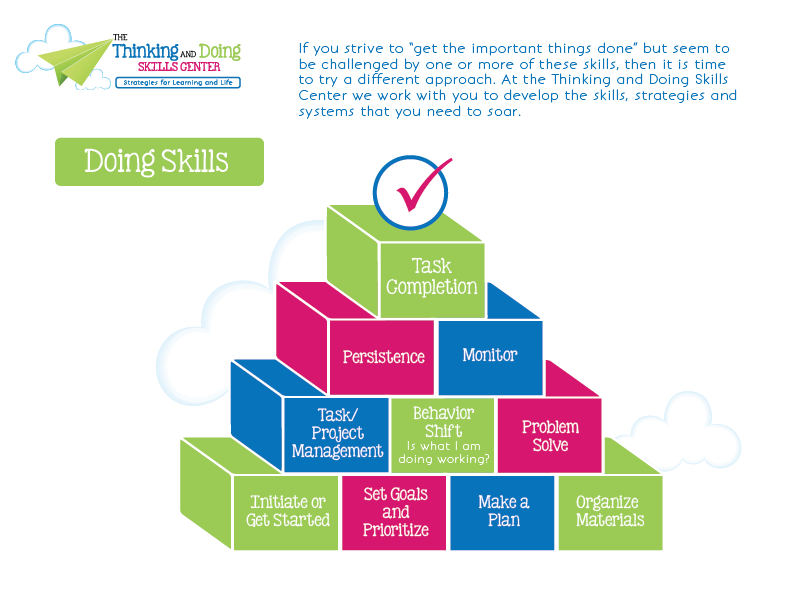
doingskills_NO-BARWith the start of the new school year, I thought it was important to revisit the art of getting started previously published on our blog in 2013.

The ability to get started on something is called “task initiation or activation” by the experts on Executive functions (Russell Barkley, Peg Dawson, Thomas Brown, etc). Executive functions are those skills that help us get things done.  Task initiation is just one of these executive skills and it involves the ability to START. Difficulties getting started can be the result of not knowing where to begin, what to do, how to generate ideas or how to problem solve to move forward on something. It differs from procrastination in that it is often not deliberate avoidance but a lack of understanding in knowing what to do to start. It can also show up as a difficulty with transitioning from one activity to another.

In children and teens, task initiation may show up as:

  • Difficulty getting started on homework
  • Struggles with generating ideas for writing
  • Problems with morning and evening routines (often needing excessive prompting to be ready for school)
  • Procrastination or being seen as unmotivated

In adults:

  • Procrastination followed by hyperfocus to meet deadlines
  • Projects that never get started
  • Unpaid or late bills, missed deadlines, and feelings of guilt

Removing the roadblocks:

  1. Is the environment getting in the way?

If your space is cluttered or you can’t find what you need to get going on something then it is time to take care of that. You end up expending more energy just looking for what you need to get started that by the time you do that, you don’t have the energy or inclination to continue. Declutter your work space, set up materials you use often in easily accessible places. Rulers, scissors, pens and pencils fit nicely in a mug on the desk. Set up colored plastic folders or boxes to hold all pieces of an ongoing project. Take everything out of the backpack and pile the “to do” items on the left and as you complete them move them to the right.

  1. Are you not sure what to do?
  • Get help understanding what is expected (call a friend or coworker).
  • Break it down into smaller pieces and pick one piece to start.
  • Work with a friend (use them as a body double to get you started).
  • Have someone tell you what to work on.
  • Use a graphic organizer.

Start with the end in mind. Sketch out what it will look like when completed and work backwards to determine the first few steps.

  1. Nudges, pokes and jabs:
  • Visual timers, alarms, and phone reminders all serve to designate a start time if you use them.
  • Set the sleep timer or automatic shut off on your TV, or use ifocusonwork.com to help shut down other distractions so you can get started on the important things.
  • Set false deadlines for yourself or have someone else set them for you.
  • Put your cellphone in another room and don’t check it until you have worked 30 minutes. Use a timer here so you are not constantly checking how much time has passed.
  • Make a deal with someone that you know has your best interests at heart and ask them to help you get started.
  1. Routines
  • Create a basic week plan so that you know what day you will do what.
  • Students set up a routine for your homework with a break, snack and start time. Then work for 30-45 minutes before taking another break.
  • Start with the easiest to build momentum.
  • Meet your friends at the library to do homework together.
  • Create a mnemonic that helps you get ready to begin and use it daily.
  • Create a play list for the length of time before you need to start and use it daily. The more you listen to it, the more your body and brain will get the message that it is time to get to work as soon as this is over.
  1. If you still can’t….
  • Just start, after about ten minutes you will get into it.
  • Create a mind map or draw out what you need to do. Use colors and shapes to help your brain remember them and pick one.
  • If you are really procrastinating on something, stop and consider, “What is the worst that could happen if I didn’t do this? If it’s not too serious, then let it go or delegate it.

Often times looming deadlines, promises to others and fear of failure will push adults to complete a task they have been putting off. Many students though are not motivated by deadlines, grades or loss of privileges. They need help in learning what is preventing them from getting started and help designing a strategy that will work for them. Our group classes can help them find the strategies that will work for the way they think. Next classes start Oct 7 and 8th.

Back to School Basics – My Five Essentials

planner-150x150Just a quick reminder about some of the basics that  are important for students heading back to school.  It may not seem like much but it can make the difference between your child using or not using the systems and when that happens, not using it can mean not doing well. So here are my top five favorites:

  1. If you’ve been reading my blog for a while you have surely seen that I am passionate about planners. It doesn’t matter to me if your child has the greatest memory ever, if they don’t have it written down somewhere then for many of them, it just conveniently slips their mind. It can be electronic or paper as long as it is used. Most schools supply an agenda or planner but fail to help the students learn to use it effectively.  Deadlines need to be where they can be seen, not just written in on the day that they were given. That is one great advantage of using a smartphone app; it will remind you about that project that is due or that upcoming test if you set it to.
  2. Binders that open with one hand or rather one finger. Fill it with notebook paper (not those spiral notebooks that always get stuck) and plastic pocket divider tabs. Some schools require separate notebooks but it is really difficult to put four or five binders into a backpack. Your teen could probably use one and just clean it out each term. I would suggest a 1.5 or 2 inch binder. Label the dividers and leave an empty pocket divider in front for a quick stash.
  3. Homework space that is ergonomic to their size and well lit. I learned that not having your feet on the floor actually raises your blood pressure. The key is to make sure your child’s arms are bent at almost a 90⁰ angle when writing with feet flat on floor or on a stool. Light the workspace rather than the room. Overhead lights often cast shadows on the work area.
  4. Pens and pencils – the good kind. There is nothing more frustrating than trying to get one of those cheap pens to write when the teacher is spewing out the homework. Buy more than you think they will need and every week have them check to be sure they have two pens and two pencils in their backpack.
  5. Create a launch pad area near the door where the backpack will live as soon as it is filled up with the day’s completed homework. Other belongings that are needed for the next day should also be there. It is helpful for younger children to have a picture checklist of what they need or a “here’s what I look like when I am ready to go to school” picture showing everything needed. Putting all necessities in the launch pad the night before allows even walking “zombies” to show up at school prepared.