
Are You Enabling or Empowering Your Child?

Empower don't enableWe all want our children to grow up to be responsible, successful members of society. Isn’t that what you want for your child? So, we “help” them at every turn so that they can make it to school on time, complete their homework perfectly, and get good grades.

But are you really helping or are you harming them?

Let me explain. If your child or teen has ADHD then you know that they struggle with routines, focus and remembering what they need to do as well as, doing what they know they need to do. You may feel that if you don’t remind your teen then they would never get out the door in the morning or finish their homework. And you may be right.

However, providing them with the information they need before they have had time to consider what comes next, does not help them develop the necessary skills to become independent instead it makes them dependent.

Think about these questions:

    1.  Are you helping your son or daughter create a routine to get out the door (with everything they need) or are you telling them what to do each day? (Ex. get your shoes on, did you brush your  teeth,  do you have your homework? And on and on.)
    2.  Are you empathizing and really trying to understand what they are feeling or are you just trying to solve their problem by telling them what they “should” do?
    3.  Are you checking their homework and making them correct it so that the teacher doesn’t know that they are struggling with it?
    4.  Are you reminding them of everything they have to do so that they don’t have to remember on their own?
    5.  Are you waking them up in the morning?

If you answered “yes” to even one of these questions, please keep reading because although you may think you are helping your children, in reality you are not. When you take away your child’s opportunity to problem solve by either telling them what they should do, or by doing it for them, not only do you handicap them from learning the skills but, you are chipping away at their self-esteem and self-confidence and fostering their dependence rather than independence.

For those with ADHD, learning routines and habits can take a bit longer than it does for those without ADHD (66 times). So it is important to start building the skills early so that by the time they get to high school, you have done your job and your teen is pretty independent. You want to feel confident that they can make it on their own at college. On the other hand, if you wait until they are a senior to start “letting go” and just drop the support you have been providing all along, they may not have the skills they need to succeed in college.

So, how can you empower them instead?

    1. Work on one thing at a time. Together decide what it will be. Empower your teen to come up with their own solutions just be sure to include how they want you to “support” them in this new process.
    2. Instead of saying you “should”…..try asking questions that lead to your teen figuring out their own solutions. Ex. “What do you think you could do to figure that out?” “How can you prevent that from happening again?”
    3. Learn about Executive Function skills so that you and your teen can better pinpoint which skill is weak. Is it getting started on things (task initiation), remembering (working memory) or finishing things (task completion) etc.? Weaknesses can occur in several executive functions but often there are EFs that are strengths as well. What looks like several areas of weakness could be the same EF showing up in a different context. How can you use the strengths to help compensate for the weaknesses?
    4. Change comes from within but here are three questions to ask that can help. Can the environment be changed to better accommodate for the weakness? Can the task be broken down into more manageable steps so that it is not so overwhelming? Does there need to be a system or a routine created to assist in solving this?
    5. Lastly, consider whether or not you are too close to the situation to really be able to help, or if you are finding it difficult to remain nonjudgmental then it may be time to find an Executive Function Coach or Counselor to work with your teen.

Jodi Sleeper-Triplett said this in her book Empowering Youth with ADHD:

…empowerment is about much more than helping the young person with ADHD accomplish goals: It’s about helping the young person identify strengths and resources; practice thinking about how to solve problems and meet goals; build skills; develop a positive self-image; and ultimately, lay a foundation for long-term success in the days, months and years to come. (p35)

And who doesn’t want that for their teen?

Basic Week Routine to the Rescue!

Routines save timeThere are two kinds of people – those that love routines and those that don’t. Which are you?
If you don’t love routines, it may be because you feel they are too restrictive, too boring or just too hard. After all, who wants to do something 66 times before it becomes automatic?

However, if you know the value of routines, then you probably appreciate the automaticity of it – following through without any real effort or brain power. Routines can keep your life on track when everything around you is falling apart. Instead of constantly trying to juggle all that is on your plate, a routine can add structure to your day and save you time, effort and money.

Routines

The most common routines are the morning, or get out of the house routine, and an evening, get ready for bed routine. There are all kinds of routines and frequencies for doing them. I encourage the students I work with to create a homework routine. They think of all the steps they should take before, during and after homework and then combine them into a routine that works for them. It may include what to do when they get home such as having a snack, taking an activity break, a body check, checking the agenda and deciding what’s important – all before even getting started. Students save themselves time by addressing all the usual distractions like hunger, thirst, feeling tired, and the “I don’t know where to start”, dilemma.

Create A Basic Week Plan

You can do the same thing by creating a routine for the things you do during your week. I call it a “basic week plan”, because it tells me when to do the basic things each week. Start with a list of the things you spend time doing throughout a typical week for yourself and your family; things like laundry, grocery shopping, bill paying, etc. If you’ve ever had to run to the grocery store for something you need for dinner that is already late, or had to pay a late fee, or missed the return window on an item that you don’t want, you know it can disrupt your day and steal valuable time you could use for yourself.

Now that you have your list, decide which day of the week would fit with your regular schedule rather than having “urgency” dictate the use of your time.

Match the task to a day:

Task                                                             Day

Laundry                                                            Monday

Groceries/Meal Planning                              Tuesday

Cleaning                                                           Wednesday

Errands                                                             Thursday

Mail/Paperwork                                              Friday

Organizing/Planning/Household Maintenance

Once you decide on the day of the week, try it out. See what it feels like to get the big stuff done during the week and have your weekend for fun and relaxation.

With fewer random or spontaneous tasks and errands taking up what little free time you have in your life, you may find the benefits of a basic week plan far outweigh the rigidity you think of in a routine. And wouldn’t it be nice to reduce the stress and the hurry in your day and to also have some time for yourself?

Recap:

  • Routines add structure to your day
  • Routines take less brain power and prevent decision fatigue
  • Routines, like a basic week plan, save you time and effort by minimizing extra errands and last-minute trips
  • Routines save money
  • Routines keep life moving even through the bumpy times

What do you need a routine for?

Use Your ADHD Super Powers and Get More Done!

ADHD Super PowersJanuary 1st is meant to encourage thoughts of possibilities but it can also be a reminder of the previous year’s disappointments. For 2024, let’s make a deal, there’s enough negativity in the world, let’s focus on the positive this year. Are you in?

It’s time to embrace our neurodiversity and use our strengths to get things done. Every January there are numerous resolution strategies offered to make this your “best year ever”. Strategies such as having a word, theme, or intention for the year are plentiful. Setting SMART goals and breaking them down into small action steps may work for some, but the statistics say differently. Many people give up within two weeks of the new year. Here’s a clip from npr.org for reasons why.

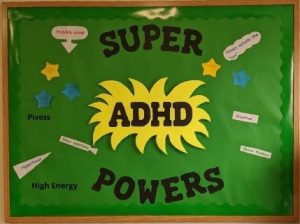
This year though, let’s try to make small improvements using our ADHD Super Powers such as: being creative and thinking outside the box, being a problem solver, having high energy and being able to pivot when necessary. Also, let’s not forget the ability to hyperfocus.

If the goal is to “get the right things done,” then let’s see how the ADHD Super Powers can help.

Super Power: You are creative:

Your ideas are innovative, often more involved than they need to be, but still creative and you often come up with non-traditional solutions that can solve problems. Watch for places where a creative solution could save you time and energy and fix it when you can. For example:

    • If you have been procrastinating on a task, add some creativity to it, gamify it, break it down into teeny, tiny doable steps to easily cross off or work on it with a friend.
    • Make it a game with the family to race around and put things away so you start each day fresh
    • Dislike using a traditional planner, then create your own system by making it work for you and the way you think.

Super Power: You have high energy:

Your energy level is often directly related to your level of motivation and of course the basics like sleep and self-care. If you find yourself with lots of energy to spare:

    • Knocking off several mini tasks will keep the dopamine level up and that makes everything easier.
    • Be sure to have a list to look at filled with those mini tasks so you don’t have to try and think of them in the moment.
    • Keep track of all you do accomplish – it’s much better to focus on what did get done rather than what didn’t.

Super Power: You can pivot quickly and change course or task:

If something more urgent comes up you are able to change gears and quickly dive into it. You are often multi-tasking and that means you are only using 50% of your brain (because you are actually switching from one task to the other and back) but you can assess what is needed and get on it. If you do have to pivot:

    • Be sure to leave yourself a note of where to pick up on the current project, before you jump to the urgent one.
    • You are able to find ways to make things easier and are open to unexpected solutions
    • Life happens – when the unexpected happens, being able to easily pivot can provide other options and solutions minimizing the disruptions.

Super Power: You can Hyperfocus:

Hyperfocus is the ability to sustain attention and focus on the task at hand until it is complete. This often entails either high interest on your part, a looming deadline, or urgency from someone else. It does use up a lot of brain power so be careful how often you use it.

    • You have the ability to deep dive into a project or area of interest so set a timer or reminder notification before beginning so you don’t miss something else.
    • Use hyperfocus to develop the skills needed for a new hobby or a side hustle.
    • The increase in focus can lead to more creative solutions and an increase in attention to details that may not happen with frequent interruptions. Let others around you know that you don’t want to be interrupted.

A change in perspective is needed if you feel that your ADHD is the reason you “can’t” get things done, are always late or forget things. Use your ADHD superpowers to come up with creative strategies and solutions for those challenges and add some fun into each day. What do you want to remember 2024 for? What do you need to do to make that a reality? Use your super powers:-)

5 Steps to a Summer with Intention

Summer of intention at the beachIt’s summer at last! Let’s take advantage of all that summer has to offer by being more purposeful and deliberate about how we chose to use our time and energy. Here are five steps to help you have a summer of intention and make great memories too.

    1. First, figure out what is important to you and your family. What interests, experiences or goals would you like to have or do this summer? Brainstorm without censoring so you can pick the most important ones.
    1. Set goals that are measurable, so you will actually know if you achieve them. Whether you want to learn a new skill, work on a hobby or go on vacation somewhere, decide what is the endgame?
    1. Since “a goal without a plan is just a wish” as Antoine de Saint-Exupéry said in his book, The Little Prince, you’ll need to create a plan for reaching those goals. Start by breaking down each goal into manageable steps then either create a routine or some structure in your day for working on the steps.

A summer plan is designed to change up the hectic routine and add some open time to enjoy the things that are meaningful to you and also make time to be spontaneous. Explore, try new activities, and take time to do nothing, whatever helps you to recharge.

    1. Next, look at your schedule to see where you can squeeze in summer. Is your vacation already planned? If not, that should be your first priority. We all have the same 168 hours per week, how are you using yours?

Are there any weekly or monthly activities that you can cut down on or bow out of for the summer? Do you have projects you can put on hold? Can you cut down or reduce the stress of those projects by letting go, delaying, picking one day a week or month to work on it or chipping away 20-30 minutes a day at it? Do whatever works for you.

Could you get up an hour earlier? Ease up on the hectic pace and change the routine to see if you can’t gain an hour or two a day for yourself. Block out some time in your planner then if something comes up it will be easier for you to say “No, I am sorry I already have a commitment on that day.” Don’t have a big block of time?

Add some spontaneous, (intentional summer) fun during the week such as:

  • breakfast on the deck
  • lunch at the park
  • a picnic dinner at the beach
  • read for 30 minutes in the hammock
  • camp out in your own backyard
  • Stargazing
  • walking the beach at night
  • riding your bike around the neighborhood

You get the idea. These are the spontaneous activities that only take a few extra minutes to do. Sometimes when we try to think of what to do in the moment, we struggle to think of ideas that aren’t really obvious. Here’s where having a list of activities and ideas that you have thought of before can make deciding so much easier. (It’s helpful for kids to come up with their own lists for when you hear the inevitable, “I’m bored!”) CHADD has an article with tips on helping your kids transition from school to summer. Read it here.

    1. Practice self-care. The summer is a great time to think about your health. Physical health; do you want to be more active, need to add more fresh, nutritious foods into your diet and/or do you need to get more sleep? Don’t forget your mental health too. What helps you recharge and/or reduce your stress? Want to start meditating, journaling or start a new hobby? Whatever it is, the summer is a great time to begin.

A summer with intention is about finding the balance between setting and working towards goals and being spontaneous. Allow yourself to embrace spontaneity and enjoy the summer season, while still staying true to your intentions. Wishing you an intentional, fun and spontaneous summer!

Are We REALLY in Control?

Life out of controlDo you ever feel like your life is a constant juggling act and that if one more thing comes at you, you’ll lose control?

When that happens, it can make us feel “out of control.” It isn’t just that one thing that causes you to drop the ball, but a combination of things. It is different for everyone but ask yourself, is it too many to-dos and not enough time? Or is it disorganization, weak boundaries (read, can’t say no) or unrealistic expectations of yourself or others?

The causes and the solutions are different for everyone. So, if you are looking for solutions to get back that feeling of control for yourself, a coach approach can provide the structure to get you the answers you need.

What is the Outcome You Want, to Feel in Control Again?

Imagine your life without this challenge – what does that look like? If you’re an adult with ADHD, how is ADHD showing up or impacting this situation? Just becoming aware of what is interfering with your ability to get to that outcome is the first step. A coach can help you explore that in a safe, non-judgmental and supportive way. They can help you narrow down your focus to one piece of the puzzle. In our example, maybe it is unrealistic expectations of yourself. Even Wonder Woman has her limits.

What Can You Do to Control The Outcome?

Brainstorm ideas and strategies keeping in mind there is no ONE right answer. You know yourself best and need to keep that in mind so that your strategy will work for the way you think. We can’t always predict what success will look like so designing an “experiment” gives an opportunity to try things out without fear of failure. Each experiment provides more data (more clues as to what will work) even if you don’t get there on the first try. Be clear on what you are committing to doing and how you will measure if it is successful or not. In a coaching relationship, you can ask the coach to hold you accountable for whatever actions you want to do.

Anything that Could Interfere with Your Plan?

A coach wants you to succeed but the responsibility is all yours as they are not attached to the outcome. You won’t be able to predict if your experiment is going to work or not but you can check to make sure there is time in your calendar to work on the experiment. Do you have everything you need to complete the experiment? When/If this works what will you learn about yourself?

Who Do You Want to Be?

Each experiment whether successful or not helps you learn more about who you are and who you want to be. It builds on your strengths and helps you find strategies you can use in other instances. In the end, we don’t do the tasks for the “fun” of crossing them off the list, we do them to show ourselves we are capable and in control of the outcome and of ourselves and our actions.

Now what can you do to take back your control?

If you’d like to learn more about how coaching can help you reach the outcomes you dream of, then let’s set up a 20-minute zoom call to chat. Email me here: laine@thinkinganddoingskillscenter.com

Time Management vs. Choice Management

time or choice

Time management, what does that mean to you? For me, it is my ability to manage the available time I have to get what needs to be done, done. Notice, I said it is MY ability to manage – myself really and manage my choices. We really can’t “manage” time as we have no control over it. It keeps going on its own whether we want it to or not. However, the choices we make of how to use our time can have a huge impact on our productivity, as well as, on how we feel about ourselves and our lives. So, what is choice management?

Choice management is taking time to look at all the options/tasks/choices you have and actually choosing your priorities given the time you have. There are lots of things that “should” be done, but are they really the important stuff or just the easy stuff? Estimate how long you think things will take before you decide if it’s a realistic task to take on.

Choose the top three priorities to begin with and set clear boundaries around the time you will work on them. Don’t wait for the deadlines to get closer as although deadlines help provide a sense of urgency, they often bring extra stress if you miscalculate the time needed to complete it.

Five Ways to Save Time

  • Use the Pomodoro method
  • Time blocking
  • Task batching
  • Create systems and routines to “keep up”
  • Organize and declutter the extras out of your life

It comes down to having to make choices because the reality is you probably can’t do it all. So rather than getting stressed, why not choose wisely and ask yourself…”is this important enough for me to use “x” hours of my day to do? Then figure out which method above, works best for you. Watch out for things that can eat up your time, like distractions, multitasking and not having a plan.

The Pomodoro Method

The Pomodoro method breaks your work time into four, 25-minute blocks of time with a 5-minute break in between each block. The short time frame tricks the brain into thinking the task is more urgent since the clock is ticking. It helps to know that you only have to work on that one “challenging or boring” task for 25 minutes and then you can take a break.

The one thing I have found to help increase it’s effectiveness is to have other people know what I am working on in that block. This body doubling technique also adds accountability to the tasks and helps to keep me on track. If you’d like to give it a try, feel free to join us for Work It Wednesday from 10am-12pm ET via zoom. (Email me for link). At the end, you are encouraged to celebrate your accomplishments and appreciate your productivity (and take a longer break).

Create Systems and Routines

We all want to work “smarter” because that makes things easier on us. Creating systems and routines is a great way to do that. Time blocking and task batching are examples of systems you can use, if they work for you. However, time management is not just about work tasks; you probably also have “home” tasks some of which occur daily.

Setting up systems and/or routines for those things can save you time and stress. For example, if there is no routine of cleaning up the kitchen after dinner (or at least before going to bed) then the morning becomes more of a hassle as you dodge last night’s dirty dishes and cluttered counters trying to get everyone out the door on time. Not to mention the extra time it takes to get dried food off.

Routines work well for weekly tasks too. Pick a day for specific things, like meal planning, grocery shopping, and laundry. Why wait until you have no clothes and there are 6 loads to do when you can keep up by doing laundry once or twice during the week. Much easier to put clothes away if it is manageable.

Organize and Declutter

Lastly, but most importantly, take the time to organize and declutter. Out of all the things you can do, this may save you the most time and frustration. We’ve all wasted time searching for things, things that either didn’t get put back in their “home” or they didn’t have a home to begin with. Your home should work for you not against you.

Create organization so that you know where the things you use daily and weekly belong. Don’t organize so you can stack more stuff into a space. Let the space determine how much can go in there and reduce your inventory. The bigger the load of laundry the longer it takes to get it to its final destination. If your clothes don’t fit in the closet or dresser once they are all clean, then (I’ll be direct) maybe you have too many clothes. Think of how much time you are using/forfeiting to laundry.

Things you use often, should be easy to get to. Why should the big lobster pot take up an entire cabinet when you only use it once or twice a year? It shouldn’t. Make life simpler by clearing counters of appliances and knick knacks you don’t use weekly. You might think it only takes a minute to move things out of the way so you can work, but those minutes add up. You are choosing to use them clearing space when you could be using them for yourself and your family.

Think about the choices you make each day. Yes, it would be wonderful to be able to do all the things we want and need to do but, there are so many options and opportunities that it is impossible to do it all. So, “choose wisely, grasshopper” as a famous TV Kung Fu master once said. Or maybe you’re inspired by Yoda’s line, “do or do not. There is no try.”  Whatever “method” you use for saving time is just one piece of the puzzle, it is the choices you make all day, every day that provides the frame work. Choose what matters to you.

Pick A Slice of ADHD Pie

Pick a slice of life with ADHD pie

January, the start of a new year. There is so much media attention on resolutions, themes, words of the year, etc. that we can easily be overwhelmed and feel like our life with ADHD is not measuring up. Well, I for one, don’t make resolutions – mostly because in the past, they never worked. I also don’t need to wait until January 1st to make a change. However, I also know that making too many changes at once….is probably not going to turn out well. So, this year, let’s try something different. Let’s pick a slice of ADHD pie to get started.

New Approach

You may have seen other “Life Wheels” similar to the one above. I designed this one with categories that relate to areas that can be challenging (or mostly ignored) for those living with ADHD.
The idea is to picture each piece of pie as being divided into 10 sections from the point in the middle to the outside edge. Ask yourself where you would rate yourself for each category from zero to ten. For example, the health category (and feel free to change these to match the areas of your life) how would you rate your health right now? Let’s say it is a 6. Mark off where a “6” might land on the pie and draw a slightly curved line to connect across. Then continue to all the other categories. Some areas may be rated higher than others. This is just a visual way to indicate areas for improvement (or for growth as coaches would say). Pick an area to focus on. Which one (yes, just one) of these will improve your life with ADHD?

Coach Yourself

        1. What would it take to bring that number closer to a 10?
        2. Why is this area important to me?
        3. What impact will an 8 or a 10 in this area have?
        4. What can I do to improve in this area? (Brainstorm all ideas)
        5. What three things can I do to make a difference in this area?

Action

        1. Pick a simple, single step action to take.
        2. When will I take this action? (Put it in your planner or phone)
        3. What can I do to make this step easier?
        4. How will I reward myself at the end of the month?
Using our example from the health category, maybe I make a healthy meal plan before I go to the grocery store. Or put my workout clothes out the night before or will I take a walk at lunch time? All simple things, that are being blocked out by other less important things or the busyness of my day. If I really want that 6 to get to an 8, then it starts…..tomorrow:-) How about you? Please share your thoughts and strategies on our Facebook page.
Related Articles from the Archives:
Look Back Before You Leap Forward in 2022
Routines, Rituals and Dopamine, Oh Yeah!

What Brings Out the Magic For You?

Not sure how it happens, but once December hits, you can feel the increased tension in the air and see it all around. I do my best to stay positive and keep my Christmas spirit up. However, some people seem to forget there are other people around them and that increased tension seems to shut down their brains Not you readers! 😊

So, this year, I am taking a hint from Cas at Clutterbug, to make a list of things that make me happy at this time of year. She called it a bucket list, but I am calling it a menu. On a menu, I can pick and choose my options and there is no competition to “eat it all.” As Cas mentions, it is easy to get “distracted” by the hustle and bustle and the list of to-dos.  That is when we miss out on the “magical” moments that the season has to offer. So, this year, let’s make a menu of the simple, no fuss things that bring us joy and then include something each day that makes us smile.

Here’s a few of my ideas to get you started. You already know the kinds of things that bring a smile to your face, so it should be easy for you to make your own list. Just be sure to add something that brings the magic to your day. Get your family involved too – everyone needs more magic.

Magic Moment Menu

      • Have a cup of hot chocolate with marshmallows (spiced cider or peppermint tea, whatever you like best)
      • Drive around your town to check out the lights
      • Bake cookies in fun shapes or a gingerbread house
      • Cas’ suggestion: “do something kind for a stranger”
      • Watch Hallmark
      • If there is snow, build a snow something….(we’ve made a dragon, giant turtle, reindeer and Santa, in the past)
      • Take a walk in the woods (even better if there is some snow)
      • Read a holiday story
      • Play Christmas charades or trivia with the kids
      • Sit in the dark with only the Christmas tree on and breathe

You get the idea. Take some time to breathe and take in the magic of this time of year. It all gets done, you know it always works out, so why not take time to enjoy those little moments. They add up to some great memories.

Wishing you all the magic of this time of year no matter what holiday you celebrate.

Routines, Rituals and Dopamine, Oh Yeah!

Rituals and routines are good habitsDo you struggle to think, problem solve or make decisions during the day? If you end up feeling overwhelmed it may be because there are just too many things swirling around in your brain. The term, “brain bandwidth” which simply means, the amount of brain resources you have in the moment, can fluctuate depending on what is going on in your life.
Think about all that your brain is responsible for behind the scenes and then it is asked to think, problem solve, and make decisions all day long too? No wonder it is always trying to “save energy” as Ed Mylett, mentions in his book, The Power of One More. We can’t create more bandwidth, but just like a computer that is slowing down, you can clear out some files to make more space.

How To Save Brain Bandwidth with Rituals

      • Create habits, routines and rituals to help
      • Reduce distractions
      • Make fewer decisions
      • Stop multi-tasking (which is really sequencing and not as effective as one thing at a time)
      • Delegate
      • Reduce your to do list
      • Let go of your phone
      • Get a good night’s sleep
      • Declutter and organize
      • Plan ahead

Let’s talk about habits. A habit (an action that has become automatic) signals your brain to go into “autopilot” mode which uses much less energy. That “automatic pilot” takes away the thought and the argument that happens when the “angel” and “devil” on your shoulders start fighting. When habits result in a positive outcome then your brain is happy. The dopamine that gets released tells your brain – this feels good, let’s do it again.

Habits when strung together become a routine. You already have routines in your life for getting up in the morning, making meals, laundry, going to bed, etc. Where’s the joy in those? No joy? Then maybe you should create a “ritual” rather than a routine.

Greg McKeown, author of, effortless (not a typo) defines a ritual as the “how” of what we do. It “infuses joy into our everyday moments.” Adding moments of joy throughout your day which lightens your day and feels good = more dopamine. He uses Marie Kondo as an example of how little rituals (like thanking that worn out pair of jeans before recycling) can add pleasure to the act of decluttering.

One ritual you may want to think about is a “Close Out the Day” ritual. A routine with added joy, pleasure, or self-care added becomes a ritual. This one ritual is a good habit that will support “future you” and save brain bandwidth also. Creating an end of the day ritual can help you start tomorrow with more focus, motivation and an early “win.”

If you are working in an office, what can you do to set yourself up for success tomorrow before leaving for home and still make it enjoyable? Same question for those of us working from home. Then getting started on your work would be as easy as “plug and play” as my friend, Alison says.

How about a ritual for the home that will create a smoother morning? Aren’t you tired of seeing dirty dishes in the morning? Creating a ritual here is a good habit to build.

We’ve mentioned before about deciding what you will eat, wear and do for tomorrow, to save decision power, but how can you add some pleasure to the process? The more pleasure = more dopamine = more brain bandwidth.

Ways to Add Pleasure to Your Ritual

      • Sitting with your favorite beverage and planning tomorrow’s big 3?
      • Take a walk
      • Spend time with your family
      • Go screen free (don’t panic, even an hour helps)
      • Read or learn something new
      • Journal
      • For some, putting the house to bed is a ritual
      • Add to a “success” list each day
      • Get up earlier so your morning isn’t rushed and enjoy a leisurely breakfast

Sometimes we think that having routines and being “pre-programmed” will be boring and take the joy out of our day. In reality, having routines for the fundamentals of your life, actually frees up brain space, which allows you to be more creative, productive, and less stressed.

A close out the day ritual the night before is a good habit to ensure you start your morning off with more decision-making power and brain bandwidth for the important things. Having routines and rituals actually gives you more freedom and energy for the significant people and priorities in your life. And isn’t that what it is all about?

Related Articles from the Archives:

Is It a Routine or a Struggle? https://thinkinganddoingskillscenter.com/is-it-a-routine-or-a-struggle/

Coffee and Routines? https://thinkinganddoingskillscenter.com/coffee-and-routines/

What Is Bugging You?

UpLevel your lifeI recently read UpLevel Now by Ursula Mentjes and it made me stop and think about a few things. The book is divided into chapters that are major life categories like health, friendships, money, spaces, time, etc. The author asks questions and gives examples of things you might be tolerating without really realizing it. She shares her experiences in each category with suggestions to help you “uplevel” or kick it up a notch. At the end of each short chapter, she asks three questions.

1. What are the top 3 things you are tolerating in this area?

2. What are the top 3 things you would like to change about that area the most?

3. What is one step you can take right now and when will you take it?

Change is hard but sometimes, we don’t even recognize that we should or need to change something that is causing us stress simply because we don’t take the time to look at it. Is it fear of change, is it an old limiting belief that is no longer true or just a big “BUT” that gets in the way? ( I would do that but….).

Up-level according to the Free Dictionary is an idiom, meaning “to make progress or improve in a specific skill or area of one’s life.” So, for instance, if you wanted to UpLevel your life you might consider ways to get healthier, have less stress, maybe you want to consider switching jobs, end a relationship that drains you, or just get organized enough to be able to find your keys every day. Whatever it is, you first need to figure out what is holding you back?

Maybe you think it will only happen that once, but then weeks or even days later, it happens again. Or the “It’ll go away” pain that doesn’t and you realize you have been tolerating it for 3 months! Or is there some fear from your past that keeps getting in the way? Sometimes it does take frustratingly long to finally realize a change is needed.

What are you tolerating that if you weren’t you would be happier, healthier, richer, better organized or more productive, or whatever it is for you?

If you have ADHD you may have learned early to adapt and change on a whim, you may not have taken the time to look at a problem long enough to think about changing it, instead you end up continuing to tolerate it and just accept it as the way it is.

Yes, ADHD can get in the way and make some things more difficult for you but that doesn’t mean you can’t do something to change it. A big part of coaching is helping people figure out what is getting in the way of them leading the life they dream of. Then breaking it down into manageable parts so that they can come up with strategies, habits, routines and ideas to make it work for the way THEY think. Other people’s suggestions don’t necessarily work for the way you think, but you have to stop and really think about what will work for you.

Also, sometimes lower self-confidence can also play a role. Maybe you feel you don’t deserve to get rid of that problem once and for all – but you do. Read that again….YOU DO!

Three coaching questions:

      1.  Think about what impact it would have on your life, if you were no longer tolerating “x”.
      2.  What is it costing you to do nothing about it?
      3.  Make just one small change at a time (when will you do it?) and watch what happens.

Looking for more help with this – Email to set up an introductory call to see if coaching is right for you.

***********